

In the digital-first era, businesses are no longer just competing on products or services; they are competing on attention, trust, and value. Content Marketing has emerged as the most effective way to establish credibility, engage with audiences, and drive long-term growth. At Appledew UK, we strongly believe that content is more than words on a page—it is the bridge that connects businesses with their target audience, turning casual visitors into loyal customers.
Content Marketing is not only about writing blog posts or creating social media updates; it is about delivering valuable, relevant, and consistent information that solves problems, educates, and builds emotional connections with potential customers. Unlike traditional advertising that pushes messages outward, Content Marketing pulls customers in by offering them genuine value. This makes it one of the most sustainable and cost-effective strategies in the digital world today.
The power of Content Marketing lies in its ability to increase visibility, improve SEO rankings, build brand authority, and nurture customer relationships. In today’s competitive digital landscape, businesses that fail to invest in content often struggle to stay relevant, while those that master it thrive across multiple channels. That’s why exploring this field deeply can help businesses unlock new levels of success.
In this blog post, we will explore every aspect of Content Marketing in detail. From its definition and importance to strategies, benefits, challenges, and future trends, we will provide a comprehensive guide that empowers businesses to harness the true potential of content. Whether you are a small startup or a large enterprise, implementing a strong Content Marketing strategy can transform your digital presence and drive exponential growth.
What is Content Marketing?
Content Marketing is a strategic approach focused on creating and distributing valuable, relevant, and consistent content to attract and retain a clearly defined audience. Unlike traditional marketing methods that prioritize selling, Content Marketing prioritizes value creation. By providing audiences with information that matters to them, businesses can build trust and foster long-term relationships that ultimately lead to conversions.
At its core, Content Marketing revolves around storytelling. Every brand has a story to tell, and content acts as the medium through which that story is shared. Whether it is through blog posts, videos, podcasts, case studies, or infographics, the goal is always to provide something meaningful to the audience. When done effectively, Content Marketing turns brands into thought leaders, positioning them as reliable sources of information within their industries.
The uniqueness of Content Marketing lies in its ability to serve dual purposes. On one side, it satisfies the informational needs of audiences by answering their questions and solving their problems. On the other side, it supports businesses by driving awareness, improving search engine visibility, and boosting customer engagement. This balance between audience benefit and business goals makes Content Marketing a win-win strategy.
In today’s digital economy, where consumers are constantly bombarded with ads, people prefer to engage with brands that provide real value rather than those that only focus on selling. Content Marketing aligns perfectly with this modern consumer mindset by shifting the focus from aggressive promotion to genuine connection.
The Importance of Content Marketing in Digital Strategy
The digital world has become highly competitive, with countless businesses striving for attention across platforms. In this environment, Content Marketing plays a vital role because it offers businesses a way to stand out not through flashy promotions, but through authentic value. Content serves as the foundation of every digital strategy—whether it is SEO, social media marketing, paid advertising, or email campaigns, none can succeed without strong, high-quality content.
One of the most significant reasons Content Marketing is crucial is its impact on visibility and search engine rankings. Google and other search engines prioritize valuable, relevant, and regularly updated content. A well-executed Content Marketing strategy ensures that businesses appear in top search results, driving organic traffic that often converts better than paid clicks. This organic presence builds long-term sustainability without the constant need for high ad budgets.
Another key benefit lies in customer engagement and trust-building. Instead of pushing products directly, Content Marketing provides audiences with helpful resources, guides, and insights. This establishes a brand as an authority in its industry and fosters loyalty among customers. A company that consistently provides valuable information is more likely to retain customers than one that only appears when trying to sell.
Additionally, Content Marketing integrates seamlessly with other digital strategies. Social media posts are fueled by content, email campaigns depend on engaging newsletters, and video marketing relies on creative storytelling. Without content, these efforts lose effectiveness. In short, content is the engine that drives all aspects of digital marketing. Businesses that ignore it risk being left behind, while those that embrace it gain a significant competitive edge.
How Content Marketing Builds Brand Authority
Building brand authority is one of the greatest strengths of Content Marketing. In today’s crowded market, where consumers have endless options, authority and trust often determine whether they choose one brand over another. By consistently producing high-quality, informative, and insightful content, businesses position themselves as thought leaders in their industries.
When audiences encounter a brand that regularly publishes blogs, guides, or research-backed content, they begin to view that brand as reliable and knowledgeable. This perception of expertise is critical for winning customer trust. For example, a company that offers in-depth content on digital marketing strategies is more likely to attract businesses seeking guidance than one that only posts promotional material.
The process of building authority through Content Marketing requires consistency, authenticity, and quality. Consistency ensures that the audience remains engaged over time. Authenticity builds trust by ensuring the content reflects genuine expertise rather than shallow promotion. Quality guarantees that every piece of content provides real value that the audience cannot find elsewhere.
Over time, this combination not only attracts a loyal audience but also enhances visibility in search results, as search engines reward authoritative content with higher rankings. Ultimately, brand authority built through Content Marketing becomes a competitive advantage, allowing businesses to stand out even in saturated markets.
Content Marketing vs. Traditional Marketing
When discussing Content Marketing, it is essential to understand how it differs from traditional marketing methods. Traditional marketing often relies on direct promotion through television ads, billboards, radio spots, or print campaigns. These methods aim to capture attention quickly, but they usually interrupt consumers rather than engage them. By contrast, Content Marketing provides a non-intrusive way to connect with audiences by offering helpful, educational, or entertaining material.
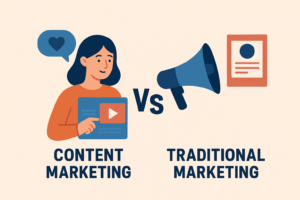 The biggest distinction lies in the value exchange. Traditional marketing often asks for immediate attention and action—“buy now,” “sign up today,” or “limited offer.” Content Marketing, however, focuses on delivering genuine value before asking for anything in return. A blog post that solves a customer’s problem, a video that explains a concept, or a podcast that entertains while educating all create a positive brand perception that naturally leads to trust and loyalty.
Another difference is the long-term impact. While traditional campaigns are time-bound and lose effectiveness once they end, Content Marketing creates assets that continue to provide value over time. For example, a well-optimized blog post can generate organic traffic for months or even years after it is published. This sustainability makes Content Marketing more cost-effective in the long run compared to traditional methods, which require continuous investment for exposure.
The contrast also extends to audience targeting. Traditional marketing often takes a broad approach, reaching anyone within a demographic group. Content Marketing, however, allows for highly specific targeting based on user interests, search behavior, or engagement patterns. This precision ensures that businesses connect with the right people at the right time, improving both relevance and conversion rates.
The Role of Storytelling in Content Marketing
At the heart of Content Marketing lies storytelling, which transforms ordinary messages into powerful narratives that captivate audiences. Humans are naturally drawn to stories—they evoke emotions, create connections, and make information more memorable. In marketing, storytelling provides the perfect way to differentiate a brand in a crowded marketplace by giving it a unique voice and personality.
Storytelling allows businesses to move beyond simply listing features or benefits of their products. Instead, they can illustrate how their offerings solve real-world problems, enhance lives, or align with customer values. For example, a fitness brand can go beyond promoting exercise equipment by sharing inspiring stories of individuals who transformed their lives through consistent training. This emotional connection strengthens the brand’s identity and builds deeper loyalty.
In addition, storytelling plays a significant role in establishing authenticity. Audiences are becoming increasingly skeptical of hard-sell advertising, but they are more likely to trust brands that share genuine stories. Whether it is the founder’s journey, customer success stories, or behind-the-scenes insights, authentic storytelling humanizes a brand and makes it relatable.
From a technical standpoint, storytelling also improves engagement metrics such as time spent on page, video completion rates, and social media shares. Content that tells a story keeps users engaged longer, which signals search engines that the content is valuable, thereby improving SEO performance. For these reasons, storytelling is not just a creative element—it is a strategic necessity within Content Marketing.
SEO and Content Marketing: A Perfect Partnership
One of the most powerful aspects of Content Marketing is its synergy with Search Engine Optimization (SEO). While SEO provides the technical foundation for visibility, Content Marketing supplies the valuable content that search engines want to deliver to users. Without quality content, SEO efforts fall flat, and without SEO, even the best content may never reach its intended audience. Together, they form the backbone of a successful digital strategy.
The role of Content Marketing in SEO begins with keyword optimization. Creating content around keywords that audiences are actively searching for ensures that businesses show up in relevant search queries. But SEO has evolved beyond keywords—search engines now prioritize content that demonstrates authority, relevance, and depth. This is where Content Marketing shines, as it focuses on producing comprehensive, informative, and engaging materials that satisfy user intent.
Another vital connection is in the area of link-building and authority. High-quality content attracts backlinks from other websites, signaling to search engines that the content is trustworthy and valuable. Over time, these backlinks improve domain authority and lead to higher rankings. Furthermore, publishing consistent, optimized content increases the likelihood of ranking for multiple keywords, driving a steady flow of organic traffic.
SEO and Content Marketing also intersect in terms of user experience. Engaging blog posts, informative videos, and visually appealing infographics keep users on a website longer, reducing bounce rates and increasing engagement—both important ranking factors. In essence, Content Marketing ensures that businesses not only appear in search results but also deliver an experience that keeps users coming back.
Types of Content in Content Marketing
One of the most fascinating aspects of Content Marketing is the wide variety of content formats available to businesses. Unlike traditional marketing, which is often limited to advertisements and promotional materials, Content Marketing allows creativity to flourish. Brands can experiment with different content types to find what resonates best with their target audience. Each format serves a unique purpose, making the overall strategy more comprehensive and engaging.
The most common form of content is the blog post. Blogs are versatile, cost-effective, and powerful for SEO, making them a cornerstone of any Content Marketing strategy. They allow businesses to cover a wide range of topics, answer customer questions, and establish authority in their field. Beyond blogs, videos have become increasingly important. With platforms like YouTube and TikTok, video content can demonstrate products, tell stories, or educate audiences in highly engaging ways.
Other effective formats include podcasts, which build a deeper connection with audiences by providing long-form discussions, and infographics, which simplify complex information into visually digestible pieces. Social media posts, case studies, whitepapers, and eBooks are also valuable formats that cater to different stages of the buyer’s journey. For instance, a quick infographic may attract initial attention, while a detailed whitepaper nurtures leads toward decision-making.
What makes Content Marketing powerful is the ability to mix and match these content types based on goals. A single campaign can use videos for awareness, blog posts for education, and case studies for conversion. By diversifying formats, businesses ensure they capture attention across different platforms and appeal to varying preferences within their audience. This multi-format approach ensures that Content Marketing remains dynamic, impactful, and relevant in a rapidly evolving digital world.
The Buyer’s Journey and Content Marketing
The buyer’s journey is a critical concept in modern marketing, and Content Marketing aligns perfectly with it. The buyer’s journey is the process that customers go through before making a purchase decision, typically divided into three stages: awareness, consideration, and decision. Each stage requires a different approach, and content plays an essential role in guiding customers smoothly through this journey.
In the awareness stage, customers are just beginning to recognize they have a problem or need. Here, Content Marketing focuses on educational and informative content that raises awareness. Blog posts, how-to guides, explainer videos, and infographics are ideal for this stage because they answer basic questions and provide clarity without being overly promotional. By offering value early on, businesses establish trust and position themselves as helpful resources.
During the consideration stage, customers are actively researching possible solutions. At this point, the content should dive deeper into comparisons, benefits, and use cases. Case studies, product guides, webinars, and detailed blog posts help customers evaluate their options. Content Marketing ensures that businesses remain visible during this stage by addressing specific concerns and highlighting unique advantages.
Finally, in the decision stage, customers are ready to make a purchase. Content here should focus on demonstrating why the business is the best choice. Testimonials, product demos, free trials, and detailed FAQs play a critical role. By addressing final objections and showcasing credibility, Content Marketing ensures that potential buyers feel confident enough to commit.
By strategically creating content for each stage of the buyer’s journey, businesses not only attract more leads but also nurture them effectively until they become loyal customers. This alignment between Content Marketing and the buyer’s journey is what makes it a highly effective tool for driving conversions and building lasting relationships.
Content Marketing for Lead Generation
One of the primary goals of Content Marketing is lead generation. While generating leads traditionally involved cold calls, flyers, or paid ads, today’s consumers prefer to engage with businesses that provide value before asking for their contact details. Content Marketing achieves this by offering high-quality, informative content that naturally encourages audiences to share their information in exchange for more value.
 For instance, a business might create an in-depth eBook or whitepaper on a relevant industry topic and offer it as a free download in exchange for an email address. Similarly, webinars and online courses serve as lead magnets by providing valuable insights while capturing attendee details. Blog posts optimized for SEO bring organic visitors who can then be guided toward conversion with strategically placed calls-to-action. These tactics turn passive readers into qualified leads.
Another powerful method within Content Marketing is gated content. Unlike freely accessible blog posts, gated content requires users to sign up or provide their details before gaining access. This ensures that only genuinely interested individuals are captured as leads. Once obtained, these leads can be nurtured further through email campaigns, newsletters, and personalized content.
The advantage of generating leads through Content Marketing lies in the quality of the audience. Leads attracted through valuable content are more likely to trust the brand and engage with future communications, compared to leads generated through aggressive sales tactics. Over time, this approach builds a pipeline of qualified prospects who are more likely to convert into loyal customers. This is why businesses that invest in Content Marketing often report not only higher lead volume but also improved lead quality.
Social Media and Content Marketing
The relationship between Social Media and Content Marketing is inseparable. While Content Marketing provides the foundation through valuable and relevant material, social media serves as the distribution channel that amplifies that content to a wider audience. Without strong content, social media pages become dull and uninspiring; without social media, even the best content might not gain the visibility it deserves. This synergy makes social platforms essential for any Content Marketing strategy.
Social media platforms such as Facebook, Instagram, LinkedIn, TikTok, and Twitter (X) give businesses the opportunity to share their blogs, videos, infographics, and case studies with a targeted audience. These platforms are not just distribution points but engagement hubs. When a business shares a high-value blog post or an engaging video, audiences interact through likes, comments, and shares, expanding the content’s reach organically. This type of interaction builds stronger connections and fosters a sense of community around the brand.
In addition, social media provides real-time feedback on Content Marketing efforts. Businesses can analyze which posts perform well, which topics generate discussions, and which types of content drive conversions. This instant feedback loop allows marketers to fine-tune their strategies quickly. Moreover, paid social media promotions further enhance the visibility of content, allowing businesses to target specific demographics, interests, and behaviors.
Ultimately, the integration of social media with Content Marketing ensures that content does not exist in isolation. Instead, it becomes part of a dynamic conversation where businesses and customers continuously exchange value. This two-way communication strengthens relationships and ensures that content reaches its maximum potential impact.
Content Marketing and Email Marketing
While social media grabs attention, email marketing remains one of the most reliable and effective channels for nurturing leads, and it works best when combined with Content Marketing. Email campaigns allow businesses to deliver personalized content directly to a customer’s inbox, ensuring consistent communication and relationship-building. Unlike social media platforms, where algorithms determine visibility, email gives businesses direct control over their message delivery.
The role of Content Marketing in email marketing is to provide engaging, valuable material that encourages subscribers to open, read, and interact with messages. A newsletter filled with helpful blog articles, industry insights, or exclusive offers adds value and keeps audiences engaged. For example, an e-commerce brand might use email to share style guides, product care tips, or seasonal advice—content that informs while subtly promoting products.
Another important aspect is segmentation and personalization. With the help of Content Marketing, businesses can create tailored content for different audience segments. A customer in the research stage might receive educational guides, while a loyal customer may get behind-the-scenes stories or early access to promotions. This customization increases open rates, click-through rates, and conversions because recipients receive content that feels relevant to their needs.
Email and Content Marketing also complement each other in lead nurturing. Gated content such as eBooks or webinars generates leads, which are then nurtured through email sequences that deliver consistent value. Over time, this builds trust and moves leads closer to making a purchase. By combining the credibility of content with the direct communication power of email, businesses can establish strong, long-lasting relationships with their audience.
Measuring Success in Content Marketing
Creating and distributing content is only half the battle; the other half is measuring success. Without analyzing performance, businesses cannot know whether their Content Marketing strategies are working or whether adjustments are needed. Success in Content Marketing is not just about traffic but about achieving specific business goals, such as engagement, conversions, or brand awareness.
One of the most important metrics is website traffic. By analyzing which blog posts, videos, or social media shares bring in the most visitors, businesses gain insights into what topics resonate most with their audience. However, traffic alone is not enough. Metrics such as time on page, bounce rate, and pages per session provide deeper understanding of how engaging the content actually is.
Conversion-related metrics are equally critical. A blog post might attract thousands of visitors, but its true value lies in how many of those visitors take desired actions—subscribing to a newsletter, downloading an eBook, or making a purchase. Tracking these conversion rates shows whether the content is effectively guiding customers through the buyer’s journey.
Additionally, social engagement metrics such as likes, shares, and comments highlight how well content performs on external platforms. Backlinks and domain authority improvements show the impact of Content Marketing on SEO. Ultimately, success should be measured against clear goals: whether it’s lead generation, sales, or brand loyalty. Regular analysis and reporting ensure that businesses refine their strategies for continuous improvement and long-term growth.
Challenges in Content Marketing
While Content Marketing offers enormous benefits, it also comes with challenges that businesses must overcome to achieve success. One of the biggest obstacles is the creation of consistent, high-quality content. Producing valuable content regularly requires creativity, time, and resources. Many businesses struggle to maintain a steady publishing schedule, leading to inconsistent engagement and reduced visibility.
Another major challenge is competition. With millions of businesses producing content daily, standing out becomes increasingly difficult. Audiences are overwhelmed with blog posts, videos, and advertisements, making it harder for brands to capture attention. To address this, companies must focus on creating unique, audience-centric content that provides deeper value rather than generic information. Without differentiation, content risks being lost in the noise.
Measuring ROI also poses difficulties in Content Marketing. Unlike direct advertising campaigns that provide immediate results, content often works in the long term. Businesses may struggle to link blog posts or social media campaigns directly to revenue, leading to uncertainty about the effectiveness of their efforts. Overcoming this requires patience, robust analytics tools, and a clear understanding of how content supports different stages of the buyer’s journey.
Despite these challenges, businesses that remain consistent and strategic often find that the rewards far outweigh the difficulties. By acknowledging these hurdles and developing solutions, companies can refine their Content Marketing strategies and build stronger, more resilient digital presences.
Content Marketing for Small Businesses
Small businesses often believe that Content Marketing is a luxury reserved for large enterprises with big budgets, but the truth is quite the opposite. Content Marketing is one of the most cost-effective strategies available, making it ideal for small businesses that need to maximize results with limited resources. By focusing on creativity, authenticity, and consistency, even small brands can achieve significant success.
One of the biggest advantages for small businesses is their ability to create personalized and authentic content. Unlike large corporations, which may rely on broad messaging, small businesses can connect more closely with their local communities or niche markets. A small bakery, for example, might use blog posts to share baking tips, or videos to showcase behind-the-scenes stories. This authenticity resonates strongly with audiences, building loyalty and trust.
Additionally, Content Marketing helps small businesses compete with larger brands by improving search engine visibility. A well-optimized blog post or video can rank alongside big-name competitors, leveling the playing field. Since audiences often turn to search engines to find local or specialized solutions, small businesses can capture valuable traffic without needing massive advertising budgets.
Most importantly, Content Marketing allows small businesses to build long-term relationships with their customers. By consistently offering value, they create a sense of community and belonging that keeps customers engaged. Over time, this loyalty translates into repeat business and word-of-mouth referrals. For small businesses seeking sustainable growth, Content Marketing is not just an option—it is a necessity.
Content Marketing for Large Enterprises
For large enterprises, Content Marketing plays a different but equally crucial role. While small businesses rely on content to establish visibility, large corporations use it to maintain authority, scale engagement, and strengthen brand identity across global markets. With access to greater resources, enterprises can invest in sophisticated strategies that reach millions of people worldwide.
One key advantage large enterprises have is the ability to diversify content formats at scale. They can produce high-quality videos, podcasts, interactive content, and large research reports alongside regular blog posts. This variety ensures they appeal to different segments of their audience and dominate multiple channels simultaneously. With dedicated teams, enterprises can maintain consistency while experimenting with innovative approaches.
Another strength lies in thought leadership and brand positioning. Large companies often use Content Marketing to shape industry conversations, publishing whitepapers, case studies, or research-backed insights that establish them as authorities. By driving discussions on emerging trends, enterprises reinforce their role as leaders in their fields, further strengthening customer trust.
However, large enterprises also face challenges in Content Marketing, such as maintaining brand voice across different departments and ensuring personalized engagement at scale. To overcome this, they rely on advanced analytics, segmentation, and automation tools that help deliver relevant content to the right audience. When executed effectively, Content Marketing allows enterprises not only to expand their reach but also to deepen their influence across diverse markets.
Future Trends in Content Marketing
The future of Content Marketing is being shaped by rapidly evolving technology, changing consumer behavior, and the demand for more personalized experiences. One of the most significant trends is the rise of artificial intelligence (AI) and automation. AI-powered tools are now being used to generate insights, personalize content delivery, and even create basic forms of content. This allows businesses to operate more efficiently while maintaining relevance in their marketing efforts.
Another key trend is the shift toward interactive and immersive content. Instead of simply reading blogs or watching videos, audiences are increasingly engaging with quizzes, polls, virtual reality experiences, and interactive infographics. These formats not only capture attention but also increase engagement by involving the audience in the content itself. As technology advances, interactive content will become a standard component of Content Marketing strategies.
Additionally, voice search and smart devices are changing the way people consume content. With the growing popularity of voice assistants like Alexa, Siri, and Google Assistant, businesses must optimize their content for voice queries, focusing on conversational language and concise answers. This shift highlights the importance of adaptability in Content Marketing, as brands must stay aligned with how audiences access information.
Sustainability and authenticity will also dominate the future. Audiences are becoming more conscious about the values of the brands they engage with. Content that emphasizes transparency, social responsibility, and genuine human connection will resonate more deeply than generic marketing messages. In the coming years, businesses that embrace these trends will remain competitive and continue to thrive.
Content Marketing and Customer Retention
While many businesses focus on Content Marketing for attracting new customers, its role in customer retention is equally important. Acquiring a new customer often costs significantly more than retaining an existing one, which makes nurturing relationships a top priority. Content Marketing provides the perfect avenue for keeping current customers engaged, informed, and loyal over the long term.
 One effective way to use Content Marketing for retention is through exclusive content tailored for existing customers. This might include loyalty newsletters, advanced tutorials, or insider updates that make customers feel valued. By providing continuous value even after the purchase, businesses strengthen relationships and encourage repeat business.
Another key strategy is using content to foster community building. When customers engage with blog posts, join webinars, or interact on social media, they feel part of a larger brand community. This sense of belonging increases emotional attachment and reduces the likelihood of customers switching to competitors. Furthermore, businesses can use feedback-driven content, such as addressing common customer concerns in FAQs or producing educational videos based on customer input, to reinforce satisfaction.
Ultimately, Content Marketing ensures that the customer journey does not end with a purchase. Instead, it continues by creating meaningful touchpoints that remind customers of the brand’s value. By investing in content designed for retention, businesses can maximize customer lifetime value and build stronger, long-term relationships.
Why Every Business Needs a Content Marketing Strategy
No matter the size, industry, or target audience, every business today needs a well-defined Content Marketing strategy. The digital world is crowded, and without a structured plan, even the best content risks going unnoticed. A Content Marketing strategy provides direction, ensures consistency, and aligns content efforts with broader business goals. Without it, content creation becomes random and ineffective.
The foundation of a successful strategy is understanding the target audience. Businesses must identify who they are trying to reach, what problems they need to solve, and what type of content will resonate with them. This clarity ensures that every piece of content serves a purpose, whether it is driving awareness, generating leads, or nurturing customer loyalty.
Another critical component is goal setting and measurement. A strong Content Marketing strategy defines clear objectives, such as increasing website traffic, boosting engagement, or improving sales conversions. It also includes key performance indicators (KPIs) that allow businesses to track success and make data-driven improvements. By setting measurable goals, businesses can ensure their efforts are not wasted and continue to evolve over time.
In today’s marketplace, where consumer trust and digital visibility determine success, having a Content Marketing strategy is not optional—it is essential. Businesses that embrace it will enjoy stronger brand recognition, higher engagement, and sustainable growth. Those that ignore it risk falling behind competitors and missing opportunities to connect with their audiences in meaningful ways.
Conclusion: Content Marketing as the Key to Digital Success
In a world where attention is scarce and competition is fierce, Content Marketing stands out as one of the most powerful strategies for businesses of all sizes. From building brand authority and generating leads to improving SEO and fostering customer loyalty, content forms the backbone of modern digital marketing. Unlike traditional advertising, which fades once the campaign ends, content provides long-term value, continuing to attract, engage, and convert audiences well into the future.
At Appledew UK, we recognize that Content Marketing is more than just a tactic—it is the foundation of digital growth. By creating authentic, valuable, and customer-focused content, businesses can establish meaningful relationships with their audiences and differentiate themselves from competitors. The journey requires consistency, creativity, and strategic planning, but the results are transformative.
As trends like AI, interactivity, and voice search reshape the digital landscape, Content Marketing will only become more important. Businesses that invest in building strong strategies today will be better positioned to succeed tomorrow. Whether you are a small business seeking visibility or a large enterprise aiming to maintain authority, Content Marketing provides the roadmap to lasting success in the digital era.