
Introduction to Paid Advertising in the Digital Age
In today’s competitive online marketplace, paid advertising has become the fastest and most measurable way to reach a targeted audience and generate consistent leads. Platforms like Google Ads and Facebook Ads have transformed how businesses market their products and services, offering powerful tools to position brands in front of the right audience at the right time. For UK businesses aiming to expand their digital presence, understanding the strategies, benefits, and best practices of paid advertising is essential.
The shift from traditional marketing channels to highly measurable digital ad platforms has allowed companies to control budgets, refine targeting, and analyse campaign performance in real-time. Whether you’re a startup or a large enterprise, mastering paid advertising can give you a competitive advantage that organic strategies alone may not achieve quickly.
Why Paid Advertising is Essential for UK Businesses in 2025
In 2025, the UK business landscape is more competitive than ever, and the way consumers discover, evaluate, and purchase products has fundamentally shifted towards the digital realm. Traditional marketing channels such as print media, TV, and radio still have their place, but they no longer command the same level of influence they once did. Instead, digital platforms—especially search engines and social media—dominate the attention of potential customers. In this environment, paid advertising has become not just an option but a core requirement for UK businesses that want to stay visible, competitive, and profitable.
The rapid evolution of consumer behaviour is one of the main reasons why paid advertising has become essential. Modern buyers expect instant access to information, personalised recommendations, and seamless online experiences. They are increasingly researching products on Google, comparing prices on e-commerce platforms, and browsing reviews on social media before making purchasing decisions. If your business is not appearing in front of them at these critical moments, you are effectively handing over opportunities to competitors who are actively investing in paid campaigns. Paid advertising ensures that your brand appears exactly where and when it matters most, whether it’s at the top of Google search results or in the newsfeed of a highly targeted Facebook audience.
Another factor that makes paid advertising indispensable is the sheer speed at which it can deliver results. Organic strategies like search engine optimisation (SEO) and content marketing are powerful but require time to gain momentum. In contrast, a well-structured paid advertising campaign can begin generating clicks, leads, and sales almost immediately after launch. For UK businesses operating in fast-moving industries or seasonal markets, this speed can be the difference between seizing an opportunity and missing out entirely. Whether it’s promoting a limited-time sale, launching a new product, or responding to a competitor’s move, paid ads give you the agility to act quickly and effectively.
Paid advertising also provides unmatched precision in targeting. In 2025, platforms like Google Ads and Facebook Ads offer advanced targeting tools that allow UK businesses to narrow their audience based on location, age, interests, online behaviour, income level, and even recent purchase history. This level of targeting means your marketing budget is spent reaching people who are most likely to convert, rather than being wasted on audiences with no interest in your product or service. For example, a London-based fitness studio can run ads that only appear to users within a five-mile radius, aged between 25 and 45, who have shown interest in gym memberships. This ability to target with pinpoint accuracy is one of the most compelling advantages of paid advertising over traditional methods.
Measurability is another critical reason why paid advertising has become essential for UK businesses. Unlike many traditional marketing channels where it can be difficult to calculate the exact return on investment (ROI), digital ad platforms provide detailed analytics that show precisely how campaigns are performing. Metrics such as impressions, clicks, cost per click (CPC), conversion rates, and return on ad spend (ROAS) can be monitored in real time, allowing businesses to quickly identify what’s working and what’s not. This data-driven approach means marketing budgets can be adjusted instantly for maximum efficiency, ensuring that every pound spent contributes directly to achieving business goals.
For small UK businesses and start-ups, paid advertising has levelled the playing field against larger competitors. In the past, national television campaigns and high-visibility billboard placements were out of reach for smaller budgets. Now, with platforms like Google Ads and Facebook Ads, even a modest investment can put your brand in front of thousands of potential customers. A carefully managed campaign with a daily budget of just a few pounds can still generate measurable results, giving small businesses a powerful tool to grow their presence without needing massive resources.

 In addition to increasing visibility, paid advertising plays a key role in building and reinforcing brand credibility. When potential customers see your business appearing consistently in search results, on their social media feeds, and across relevant websites, it creates a sense of trust and familiarity. This is particularly important in the UK market, where consumers are often cautious about trying new brands. Paid ads help establish your business as a legitimate and active player in your industry, which can significantly improve the likelihood of customers choosing you over a competitor.
The competitive nature of the UK digital marketplace further underscores the importance of paid advertising. In many industries, organic search rankings are dominated by established players with years of SEO investment. Relying solely on organic strategies can mean waiting months or even years to appear on the first page of Google. Paid advertising offers a direct route to premium placement, allowing new and growing businesses to compete head-to-head with industry leaders from day one. This visibility can drive traffic, build brand awareness, and create sales opportunities that would otherwise be difficult to achieve.
Consumer attention spans are shorter than ever, and the sheer volume of content competing for that attention is staggering. Without a strategic paid advertising plan, it’s easy for your message to get lost in the noise. Paid ads cut through that clutter by placing your message directly in front of your ideal audience at precisely the right time. Whether it’s a visually engaging Facebook carousel ad, a persuasive Google search ad, or a targeted YouTube video ad, paid advertising gives you the ability to capture attention quickly and guide potential customers toward taking action.
Another reason paid advertising is essential in 2025 is its ability to adapt to changing market conditions. Economic fluctuations, shifting consumer trends, and technological advances can all impact buying behaviour. Paid advertising allows UK businesses to pivot rapidly, testing different messages, offers, and creatives in real time. This adaptability is crucial for staying relevant and competitive in a constantly changing business environment.
Finally, paid advertising is no longer just about driving immediate sales—it’s also a powerful tool for long-term growth. Retargeting campaigns, for example, allow businesses to stay connected with people who have already visited their website or engaged with their social media content. This ongoing exposure keeps your brand top of mind, nurturing leads until they are ready to make a purchase. Combined with brand awareness campaigns, paid advertising helps create a steady pipeline of potential customers, ensuring sustainable growth over time.
In short, paid advertising in 2025 has become an essential element of a successful marketing strategy for UK businesses. It offers the speed, precision, measurability, and adaptability needed to thrive in an increasingly digital, competitive, and fast-paced marketplace. By leveraging advanced targeting, AI-driven optimisation, and data-rich analytics, businesses can ensure that every advertising pound is invested wisely. Those who embrace paid advertising not only stand to gain immediate visibility and sales but also position themselves for long-term success in the ever-evolving UK business landscape.
Understanding Google Ads and How It Works
Google Ads is a pay-per-click (PPC) advertising platform that displays your ads on Google’s search results and partner websites. Advertisers bid on specific keywords, and when a user searches for those terms, Google’s algorithm determines which ads appear. Your position in search results depends on a combination of bid amount, ad quality, and relevance.
The strength of Google Ads lies in search intent targeting. When someone types “best SEO company in London,” they’re actively looking for that service. By appearing at the top of search results, you’re catching them at the decision-making stage. Google Ads also offers display campaigns, YouTube ads, and shopping ads, allowing for diverse marketing strategies tailored to different customer journeys.
Understanding Facebook Ads and How It Works
Facebook Ads operate on a slightly different model. Instead of targeting users based on keywords, they target based on interests, behaviours, demographics, and online activities. The Facebook Ads ecosystem includes Instagram, Messenger, and the Audience Network, giving advertisers access to billions of active users.
The key advantage of Facebook Ads is its deep audience segmentation. You can target specific age groups, locations, hobbies, or even people who have interacted with your brand before. This makes it ideal for brand awareness campaigns, remarketing efforts, and visually engaging promotions.
Key Differences Between Google Ads and Facebook Ads
In the ever-evolving landscape of digital marketing in the UK, two platforms dominate the paid advertising space — Google Ads and Facebook Ads. While both aim to help businesses reach their target audience and drive conversions, they operate in fundamentally different ways, each offering unique advantages depending on your business goals, industry, and budget. Understanding these distinctions is essential for creating an effective and profitable advertising strategy in 2025.
Google Ads is primarily a search-based advertising platform. It works on an intent-driven model, meaning your ads are shown to users actively searching for specific products, services, or information. For example, if someone searches for “best web design company in London,” a well-targeted Google Ad can place your business at the very top of the search results. This makes Google Ads ideal for capturing demand that already exists. The platform also offers display ads, YouTube ads, and shopping ads, but its core strength lies in paid search.
In contrast, Facebook Ads operates on an interest-based targeting model. Users on Facebook and Instagram aren’t necessarily looking for your product when they see your ad. Instead, the platform uses advanced algorithms to place your ad in front of people who match your target demographic, interests, and behaviors. This makes Facebook Ads exceptional for creating demand and building brand awareness, especially when your audience might not even realize they need your product or service yet.
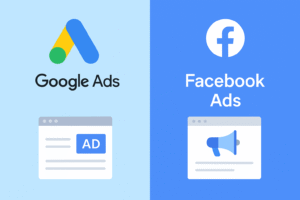 Another major difference lies in audience intent. With Google Ads, the audience has a higher purchase intent because they are actively searching for something specific. On the other hand, Facebook Ads often reach people who are casually browsing, which may result in a longer nurturing process before they convert into paying customers. This difference directly affects the conversion rate, cost per click, and overall ROI of each platform.
When it comes to ad creatives, Facebook Ads rely heavily on engaging visuals, videos, and storytelling to capture attention in a crowded social feed. Creative quality plays a huge role in whether the ad performs well. Google Ads, however, is often more text-driven in search campaigns, requiring compelling copy and strategic keyword targeting to ensure maximum visibility.
Budget allocation is also an important factor. Google Ads can sometimes be more expensive per click in competitive industries, but the higher intent of the audience can justify the cost. Facebook Ads, while often cheaper per click, may require longer campaigns and retargeting strategies to achieve similar conversion results.
In short, Google Ads excels at meeting existing demand, while Facebook Ads thrives in generating new demand. For UK businesses in 2025, a smart approach often involves using both platforms strategically — leveraging Google Ads for immediate, high-intent leads and Facebook Ads for brand awareness, engagement, and long-term customer growth. Understanding these differences allows businesses to allocate budgets wisely and maximize the returns from their paid advertising efforts.
Creating High-Performing Google Ads Campaigns
In the competitive landscape of digital marketing, creating high-performing Google Ads campaigns is essential for driving targeted traffic, generating quality leads, and maximising return on investment. Google Ads offers a powerful platform to connect with potential customers at the exact moment they are searching for products or services you provide. However, achieving optimal results requires a strategic approach that blends keyword precision, compelling ad copy, and continuous optimisation.
The process begins with thorough keyword research to identify search terms that align with your audience’s intent. Choosing the right keywords—balanced between high search volume and manageable competition—ensures that your ads appear in front of users most likely to convert. Crafting engaging and relevant ad copy that highlights your unique selling proposition and includes a clear call-to-action is vital for capturing attention and encouraging clicks.
Another critical factor is landing page relevance and optimisation. Directing users to a well-designed, fast-loading, and conversion-focused page increases the likelihood of turning clicks into sales or enquiries. Google’s quality score system rewards advertisers who deliver relevant ads and seamless user experiences, often resulting in lower costs per click.
Ongoing campaign monitoring is key to maintaining and improving performance. Analysing metrics like click-through rate, conversion rate, and cost per acquisition allows for data-driven adjustments, such as refining targeting, optimising bids, or testing different ad variations.
Ultimately, creating high-performing Google Ads campaigns is about combining strategic keyword targeting, persuasive messaging, and constant optimisation to achieve measurable and scalable business growth.
Creating High-Performing Facebook Ads Campaigns
In today’s digital marketplace, creating high-performing Facebook Ads campaigns requires a perfect blend of creativity, targeting precision, and data-driven optimisation. Facebook remains one of the most powerful platforms for reaching potential customers, thanks to its advanced audience segmentation tools and vast user base. However, success on this platform doesn’t come from simply boosting posts—it demands a well-structured approach that aligns with your brand’s goals and audience behaviour.
The foundation of a successful campaign lies in identifying your ideal audience and crafting messages that resonate with their needs, interests, and pain points. Compelling visuals, persuasive ad copy, and a clear call-to-action are critical elements that can make your ad stand out in a crowded newsfeed. By leveraging Facebook’s detailed targeting options—such as demographics, interests, and behaviours—you can ensure that your ads reach the right people at the right time.
Equally important is continuous monitoring and optimisation. Analysing performance metrics like click-through rates, conversion rates, and cost per acquisition allows you to adjust your strategy in real time. This might involve A/B testing different creatives, experimenting with ad placements, or refining your bidding strategy to achieve better results.
Ultimately, creating high-performing Facebook Ads campaigns is about combining creativity with strategic thinking. Brands that invest time in understanding their audience, delivering value-driven content, and optimising their campaigns consistently will see stronger engagement, higher conversions, and a more substantial return on their ad spend. With the right approach, Facebook Ads can be a driving force for scalable business growth.
Budgeting for Paid Advertising
One of the advantages of Google Ads and Facebook Ads is the flexibility in budgeting. You can start with as little as a few pounds per day and scale as you see positive results. The key is to focus on cost per click (CPC), cost per acquisition (CPA), and return on ad spend (ROAS).
Setting realistic budgets ensures you don’t overspend while still gathering enough data to make informed decisions. A well-structured budget also allows for experimentation with new campaigns without risking core revenue streams.
Tracking and Measuring Ad Performance
Without proper tracking, you’re essentially guessing whether your campaigns are successful. Conversion tracking tools in both Google Ads and Facebook Ads let you see exactly how users interact with your ads, from clicks to purchases. Integrating analytics software like Google Analytics provides deeper insights into user behaviour, helping refine targeting and messaging.
Regular performance reviews highlight underperforming campaigns and allow you to reallocate resources to more profitable areas. Data-driven decision-making is the backbone of long-term paid advertising success.
Avoiding Common Paid Advertising Mistakes
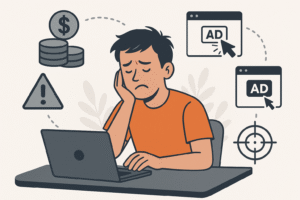 Many UK businesses waste advertising budgets by making simple but costly mistakes. These include targeting too broad an audience, failing to test ad creatives, ignoring negative keywords, or neglecting landing page optimisation. Without careful monitoring, even the best ads can lose effectiveness over time.
To avoid these pitfalls, focus on continuous optimisation, ensure your message is consistent across all platforms, and keep learning from campaign data. The digital advertising landscape changes rapidly, and staying updated with best practices is crucial.
The Future of Paid Advertising in the UK
As the UK steps further into 2025 and beyond, the future of paid advertising is being shaped by an unprecedented convergence of advanced technology, shifting consumer behaviour, and increasing regulatory oversight. What once relied heavily on static banner ads and broad-targeted campaigns is now evolving into a sophisticated, data-driven ecosystem capable of delivering highly personalised messages to individual consumers at precisely the right moment. The advertising industry is entering an era where artificial intelligence, automation, and immersive formats will redefine how brands connect with audiences.
One of the most significant developments shaping the future of paid advertising in the UK is the deep integration of artificial intelligence and machine learning into ad platforms. Both Google Ads and Facebook Ads are continuously enhancing their AI-powered algorithms to better understand user intent, predict purchasing behaviours, and automate bidding strategies. This means businesses can rely on these systems to optimise campaigns in real-time, ensuring that ads are shown to the right audience without constant manual adjustments. For UK advertisers, this automation is not about replacing creativity but rather about enabling brands to focus on crafting high-quality messages while letting AI handle the complex data analysis behind the scenes.
Another transformative force is the rise of privacy-focused advertising. In recent years, consumers have become more conscious of how their data is used, and regulatory changes such as the UK GDPR have tightened the rules for collecting and processing personal information. Tech companies have responded by phasing out third-party cookies and introducing privacy-friendly targeting solutions. Google’s Privacy Sandbox, for example, aims to deliver relevant ads without compromising user privacy, while Facebook is experimenting with aggregated event measurement to maintain accurate targeting despite data restrictions. This shift means that UK advertisers must learn to thrive in a world where first-party data—information collected directly from customers—becomes the most valuable asset. Building trust through transparent data practices will be critical for long-term advertising success.
Immersive advertising formats are also set to play a major role in the UK’s paid advertising landscape. Augmented reality (AR) and virtual reality (VR) ads are no longer experimental—they are becoming mainstream marketing tools. Brands can now invite potential customers to virtually try on clothes, see how furniture fits into their homes, or explore a new product in 3D before purchasing. These interactive experiences create a deeper emotional connection between the consumer and the product, resulting in higher engagement rates and stronger brand recall. Platforms like Facebook’s AR ads and Google’s 3D display ads are leading the charge, offering UK businesses innovative ways to stand out in an increasingly crowded digital environment.
Video advertising will continue to dominate, but the way it is delivered is evolving rapidly. Short-form videos, particularly those optimised for platforms like TikTok, Instagram Reels, and YouTube Shorts, are capturing the attention of UK audiences at an unprecedented rate. These bite-sized, engaging videos are proving to be highly effective for paid campaigns, especially when combined with storytelling techniques that resonate emotionally with viewers. Meanwhile, shoppable video ads are bridging the gap between entertainment and e-commerce, allowing users to purchase directly from within the video without leaving the platform.
Voice search and voice-assisted advertising are also on the rise, driven by the widespread use of devices like Amazon Echo, Google Nest, and Apple’s Siri. UK consumers are increasingly using voice commands to search for products and services, meaning advertisers will need to adapt their strategies for a conversational, voice-friendly format. This shift opens up opportunities for sponsored voice results and voice-activated promotions that blend seamlessly into the user’s daily interactions with smart devices.
In addition to new formats, the future of paid advertising in the UK will see a greater emphasis on predictive analytics and intent-based targeting. Instead of reacting to consumer behaviour after it happens, advertisers will be able to anticipate purchasing decisions based on patterns, seasonal trends, and real-time contextual signals. This forward-looking approach will allow brands to reach potential customers before they actively start searching, increasing the likelihood of conversion. AI-driven predictive modelling will become a standard feature within ad platforms, giving UK businesses a competitive edge in reaching high-value prospects.
Another defining characteristic of the future advertising landscape is the blending of online and offline experiences. As the boundaries between digital and physical retail continue to blur, advertisers will use paid campaigns to drive both online conversions and in-store visits. Technologies like geofencing and proximity marketing will enable hyper-local targeting, delivering personalised offers to consumers the moment they enter a specific area or store. This level of precision marketing is particularly promising for UK retailers looking to merge their e-commerce strategies with brick-and-mortar operations.
Sustainability and ethical advertising are emerging as powerful forces in shaping brand perception. UK consumers, especially younger generations, are increasingly choosing to support brands that align with their values. This means paid advertising campaigns will need to go beyond product promotion, incorporating messages about sustainability, social responsibility, and ethical business practices. Authenticity will be key, as audiences are quick to detect and reject insincere marketing efforts. Platforms themselves are also encouraging this shift, with ad formats that highlight eco-friendly products or promote charitable initiatives.
The role of influencer marketing within paid advertising will continue to expand. Rather than relying solely on organic influencer content, brands are increasingly using paid promotions to amplify influencer partnerships. This hybrid approach allows businesses to leverage the credibility of influencers while ensuring their message reaches a wider, targeted audience. Micro-influencers, with their niche but highly engaged followings, are proving to be especially effective for UK advertisers looking for high trust and strong conversion rates.
Automation will also extend beyond bidding and targeting into creative production. AI tools are already capable of generating multiple ad variations tailored to different audience segments, adjusting headlines, images, and calls-to-action dynamically based on performance data. This level of personalisation at scale was once impossible, but it is quickly becoming the norm in the UK’s paid advertising environment. The ability to deliver thousands of personalised ad versions simultaneously will dramatically increase campaign relevance and efficiency.
Finally, the future of paid advertising in the UK will be characterised by a heightened focus on measurement and attribution. With the decline of traditional tracking methods, businesses will turn to multi-touch attribution models and advanced analytics to understand the full customer journey. This will enable advertisers to determine which touchpoints have the most influence on conversions and allocate budgets more effectively. The ability to connect advertising spend directly to revenue outcomes will not only improve ROI but also justify continued investment in paid campaigns during uncertain economic times.
In summary, the future of paid advertising in the UK is moving toward a more intelligent, privacy-conscious, and immersive experience. Success will depend on how well businesses adapt to AI-driven automation, embrace emerging formats like AR and voice search, and build authentic connections with their audiences. Brands that prioritise first-party data, ethical messaging, and advanced personalisation will be best positioned to thrive in this new era. The pace of change is accelerating, and while the opportunities are immense, so too is the competition. Those who invest now in mastering the evolving landscape of paid advertising will secure a lasting advantage in the UK’s digital marketplace.
Conclusion: Maximising ROI with Paid Advertising
In the competitive world of digital marketing, maximising ROI with paid advertising is about more than simply running ads—it’s about creating smart, data-driven campaigns that deliver measurable results. A well-planned paid advertising strategy ensures that every pound spent works towards generating leads, conversions, and long-term customer value. The key lies in precise targeting, engaging creatives, and continuous optimisation to ensure ads reach the right audience at the right time.
When done correctly, paid advertising can significantly amplify brand visibility, drive consistent traffic, and outperform many traditional marketing methods. However, without the right approach, costs can spiral while results stagnate. That’s why it’s essential to monitor performance metrics, refine strategies based on analytics, and adjust budgets to focus on the most profitable campaigns. This process not only improves efficiency but also maximises the return on every marketing pound invested.
At Appledew UK, we specialise in crafting high-performing advertising campaigns tailored to each client’s unique goals. Our expertise in platforms like Google Ads and Facebook Ads ensures that every campaign is optimised for maximum reach and profitability. We believe that success in paid advertising comes from combining creativity with analytical precision, enabling brands to scale effectively while maintaining cost control.
Ultimately, maximising ROI with paid advertising is about balance—investing strategically, adapting quickly, and focusing on what works best for your audience. In today’s competitive digital landscape, those who embrace a performance-driven mindset will see their advertising efforts translate into sustainable business growth.