

Search Engine Optimization helps businesses improve Google rankings, attract qualified organic traffic, strengthen online visibility, and generate sustainable leads through proven SEO strategies.
Introduction
Search Engine Optimization (SEO) is one of the most valuable long-term investments a business can make in its digital presence. When people need a product, service, or answer to a question, they frequently turn to search engines to discover relevant websites. If a business appears prominently for the searches its potential customers make, it has more opportunities to attract qualified visitors, establish credibility, and generate enquiries. However, earning that visibility requires more than inserting keywords into website content. Successful SEO combines helpful information, technical performance, accessible website design, relevant page structure, and a clear understanding of what users want to accomplish.
For businesses operating in competitive markets, an effective SEO strategy creates opportunities to reach customers throughout their decision-making journey. Someone searching for general information may be exploring a problem, while another person searching for a specific service may be ready to compare providers or request a quotation. By developing content that addresses these different needs, a business can become a useful resource before, during, and after a purchasing decision. Organic search visibility can also complement paid advertising, social media marketing, email campaigns, and conversion rate optimization. Unlike advertising placements that depend directly on ongoing media expenditure, organic search traffic can continue generating visits after the initial investment in content and technical improvements, although maintaining visibility still requires ongoing work.
At Appledew UK, the objective of a well-planned SEO approach is to help businesses develop a stronger, more sustainable online presence through strategic optimization and meaningful user value. Effective Search Engine Optimization begins with realistic goals, relevant keyword research, and an understanding of the audience a website needs to serve. It also depends on honest measurement, consistent improvement, and a commitment to providing accurate information rather than attempting to manipulate search rankings. Google does not guarantee first-page rankings for any website, and no responsible SEO professional can promise a particular position. The more sustainable approach is to build a website that deserves to be discovered: one that answers important questions, communicates expertise, performs reliably, and makes it easy for visitors to take their next step.
Understanding Search Engine Optimization and How It Works
Search Engine Optimization is the process of improving a website so search engines can discover, understand, index, and potentially display its pages for relevant searches. SEO also involves improving the experience people receive after clicking a search result. These activities work together because a page must be accessible and understandable to search engines, relevant to a user’s query, and useful enough to justify its visibility. Search engines evaluate many signals when determining which results to show, and the relative importance of those signals can vary according to the query, content type, and search context. Consequently, SEO is not a single technical adjustment or marketing trick. It is a coordinated process involving content quality, website architecture, page performance, reputation, and ongoing analysis.
Search engines generally work through three core activities: crawling, indexing, and serving search results. Crawling occurs when automated systems discover and access URLs to examine their content and links. Indexing involves analyzing eligible content and storing information about pages that the search engine considers suitable for inclusion in its index. Ranking and result presentation happen when the search engine evaluates available information to identify pages that may best satisfy a particular query. A page can be published without being indexed, and an indexed page is not guaranteed to rank prominently. Crawl restrictions, duplicate content, technical errors, weak relevance, and insufficient differentiation can all affect visibility. Website owners should therefore monitor whether important pages are accessible, indexable, and supported by a logical internal linking structure.
A successful SEO strategy addresses the different factors involved in this process rather than concentrating exclusively on rankings. Technical SEO helps search engines access and interpret a website. On-page SEO improves the relevance, structure, and clarity of individual pages. Content SEO ensures that information answers real questions and provides meaningful value. Off-page SEO focuses on reputation and relevant references from other websites, while local SEO supports businesses serving specific geographic areas. These disciplines overlap, so an improvement in one area may support another. For example, a well-researched service page can become more useful when it has a descriptive title, clear headings, accessible navigation, strong supporting evidence, and relevant internal links. Google’s official SEO Starter Guide provides a useful foundation for understanding how websites can be made easier for search engines and people to use.
Setting Clear SEO Goals and Defining Business Objectives
An effective SEO campaign begins with a clear understanding of what the business wants to achieve. Increasing organic traffic may be useful, but traffic alone does not necessarily indicate commercial success. A website can attract thousands of visitors who have no interest in its products or services and generate very few enquiries. Another website may receive a smaller number of highly relevant visitors who regularly request quotations, book consultations, or purchase products. Before choosing keywords or publishing content, businesses should identify the outcomes that matter most, such as qualified leads, online sales, appointment bookings, product discovery, newsletter registrations, or growth in relevant brand searches.
SEO objectives should be connected to measurable indicators and a realistic timeframe. For example, a service business might aim to improve organic enquiries from relevant service pages over six months, while an online retailer might focus on increasing organic revenue from carefully selected product categories. Supporting indicators could include non-branded organic clicks, impressions, click-through rate, landing-page engagement, conversion rate, and the number of important pages indexed. These measures should be interpreted together because each provides a different perspective. A rise in impressions without corresponding clicks may suggest that page titles, descriptions, query relevance, or ranking positions deserve investigation. Higher traffic without more enquiries may indicate a mismatch between search intent and the landing-page experience.
A practical SEO plan also accounts for available resources, competition, website condition, and the amount of work required. A small company with limited content production capacity should prioritize a manageable number of valuable service pages and supporting articles rather than attempting to publish dozens of low-quality pages each month. An established website may need to address indexing problems, consolidate overlapping articles, or improve existing pages before creating new content. Businesses should document their starting position so later performance can be compared with a meaningful baseline. It is also important to consider seasonal demand, algorithm changes, changes in competitors’ activity, and updates to products or services when interpreting results. SEO is rarely a straight line of continuous growth. Clear goals help teams distinguish meaningful progress from temporary fluctuations and focus their effort on improvements that support business performance.
Conducting Keyword Research for Relevant Organic Traffic
Keyword research identifies the language people use when searching for information, products, services, and solutions. It helps businesses understand the subjects their audiences care about and the phrases that may connect those audiences with relevant website pages. Effective research considers more than search volume. A keyword with a large estimated audience may be difficult to rank for or may attract visitors who are not ready to take meaningful action. A more specific phrase with lower search demand can sometimes generate better commercial results because it communicates a clearer need. The purpose of keyword research is therefore to identify relevant opportunities that align with audience needs, business expertise, competitive conditions, and realistic content capabilities.
A useful starting point is to create a list of core services, products, customer problems, and common questions. A web design company, for instance, might investigate searches related to website design services, website redesign, mobile-friendly websites, ecommerce development, website maintenance, and website costs. Each broad topic can be expanded into more specific phrases by considering industry, location, audience type, desired outcome, and common objections. Search suggestions, customer enquiries, sales conversations, competitor page structures, and data from Google Search Console can reveal useful language. Keyword research tools can provide estimates of search demand and competition, but their figures should be treated as directional rather than exact predictions of future traffic. Actual performance depends on the quality of the page, the search results, the audience, and many other factors.
After collecting potential keywords, group related terms according to their meaning and the intent behind them. Closely related phrases may belong on a single comprehensive page, while keywords representing distinct needs may require separate resources. For example, a page targeting a commercial SEO service should not be expected to fully satisfy a user seeking a beginner’s explanation of SEO terminology. Similarly, creating multiple pages that target nearly identical phrases without a meaningful difference can cause unnecessary duplication and make it difficult to determine which page should rank. A keyword map helps assign one primary topic to each important URL, alongside relevant secondary terms and supporting questions. Review the map periodically as services change, search demand evolves, and performance data reveals new opportunities. The objective is not to force every keyword into the copy; it is to organize the website around the subjects that matter to real users.
Understanding Search Intent and the Customer Journey
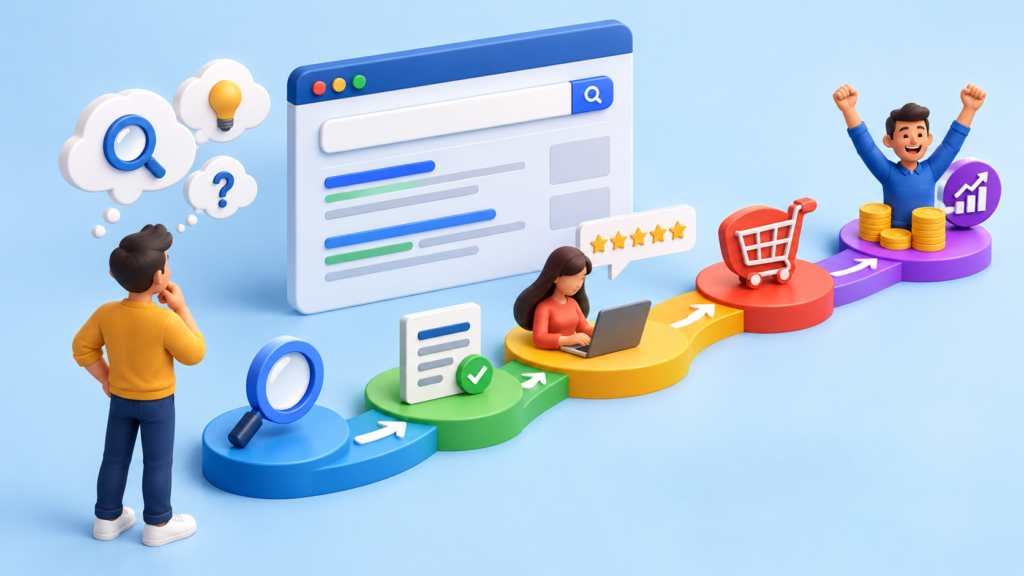
Search intent describes the underlying reason a person performs a search. Understanding it is essential because a page can include the correct keywords and still fail to satisfy the user. Someone searching for “what is SEO” is probably looking for an explanation, while a person searching for “SEO agency pricing” may be comparing potential providers. A search for a particular company’s name may indicate navigational intent, whereas a detailed product query may signal a desire to evaluate specifications before purchasing. These distinctions influence the type of content, level of detail, page format, and calls to action that are appropriate for each search.
Four commonly used intent categories are informational, navigational, commercial investigation, and transactional. Informational searches call for useful explanations, tutorials, definitions, and practical guidance. Navigational searches involve finding a particular website or destination. Commercial investigation searches often involve comparisons, reviews, feature assessments, pricing information, or advice about choosing a provider. Transactional searches suggest that the user is ready to perform an action, such as buying a product, requesting a quote, or booking a service. These categories are useful planning tools rather than rigid rules, and one query may reflect several overlapping needs. Reviewing the existing search results can help identify the content formats Google currently considers relevant to a query.
Mapping content to the customer journey enables businesses to support potential customers before they are ready to make a purchase. Early-stage content can explain problems and possible solutions, middle-stage resources can compare approaches and clarify selection criteria, and decision-stage pages can describe services, processes, pricing factors, evidence, and next steps. A helpful informational article might link naturally to a relevant service page for readers who want professional assistance. A service page, in turn, can provide access to case studies, FAQs, and supporting resources that help visitors make an informed decision. This structure should feel like a useful pathway rather than a series of aggressive sales messages. When each page has a clear purpose, users can find answers more easily, and search engines receive stronger contextual signals about the relationship between different parts of the website.
Creating High-Quality SEO Content That Demonstrates E-E-A-T
High-quality content is central to sustainable organic search performance because it gives users a meaningful reason to visit, read, trust, and return to a website. Useful content answers the main question clearly, explains relevant details, anticipates common concerns, and helps readers make informed decisions. It should reflect the needs of the intended audience rather than simply repeat information already available across competing websites. Depending on the topic, valuable additions may include original analysis, practical examples, step-by-step instructions, documented experience, expert commentary, useful comparisons, or evidence that supports important claims. The goal is not to make every page longer than competing pages. It is to make the page sufficiently complete, accurate, and helpful for the task it is intended to serve.
Google describes the concept of E-E-A-T through experience, expertise, authoritativeness, and trustworthiness. These qualities are particularly important when content could affect people’s health, finances, safety, or other significant decisions, although trustworthy content matters across all subjects. Experience may be demonstrated through genuine first-hand observations, documented projects, or practical examples. Expertise involves appropriate knowledge and the ability to explain a subject accurately. Authoritativeness can be supported by a credible reputation within a relevant field, while trustworthiness depends on accuracy, transparency, reliable evidence, and honest communication. E-E-A-T is not a single ranking score that website owners can directly optimize. Instead, it is a useful framework for reviewing whether a website provides the kind of reliable information that users should be able to expect.
Businesses can strengthen content credibility by identifying authors where appropriate, checking technical and factual claims, citing reliable sources, disclosing relevant limitations, and updating information when it becomes outdated. Service pages should explain what a business actually offers without inventing customer results, credentials, or guarantees. Case studies should use genuine evidence and clearly distinguish measured outcomes from opinions or estimates. AI-assisted writing can support research, outlining, and editing, but the final content still needs human oversight, factual verification, and meaningful value. Publishing large quantities of repetitive pages without adding anything useful is unlikely to create a sustainable advantage. Google’s guidance on creating helpful, reliable, people-first content offers a practical standard for evaluating whether a page genuinely serves its intended audience.
On-Page SEO Optimization for Better Relevance and Clarity
On-page SEO involves improving the visible content and HTML elements of an individual page so its purpose is clear to users and search engines. Important elements include the page title, main heading, subheadings, body copy, image descriptions, internal links, and URL. These elements should communicate the page’s subject consistently without becoming repetitive or unnatural. A well-optimized page answers the main query early, expands on relevant subtopics, and organizes information in a logical sequence. The primary keyword can appear naturally in the title, main heading, introduction, and other appropriate places, but it does not need to be repeated a fixed number of times. Search engines can understand related concepts and context, so readability and completeness matter more than achieving an arbitrary keyword density.
The HTML title element is particularly important because it helps communicate the page’s topic and may influence the title displayed in search results. A useful title is specific, concise, and relevant to the content. For example, “Technical SEO Services for Growing Businesses” communicates a clearer purpose than a vague title such as “Welcome to Our Website.” Search engines may generate a different title link when they believe another page element better represents the result, so the displayed wording is not entirely under the publisher’s control. A meta description can provide a concise, accurate summary of the page and may be used to form the search-result snippet, although Google can choose other page text. Both elements should describe real value rather than make unsupported promises or repeat a list of keywords.
Headings help readers scan a page and understand its information hierarchy. A clear H1 generally identifies the main topic, while H2 and H3 headings organize major sections and supporting points. Descriptive URLs can also help people understand what a page covers before visiting it. Images should be relevant and appropriately sized, with descriptive alternative text when the image conveys information. Decorative images can use empty alternative text so assistive technologies can skip them. Internal links should use natural anchor text that accurately describes the destination, enabling users to explore related resources. Finally, every important page should have a clear purpose and an appropriate next step, whether that is reading another guide, comparing a service, contacting the business, or completing a purchase. Effective on-page optimization combines relevance, accessibility, clarity, and usefulness into one coherent experience.
Technical SEO, Indexing, Security, and Website Performance
Technical SEO focuses on the systems and website elements that affect crawling, indexing, rendering, and reliable access to content. Even excellent articles and service pages may struggle to gain organic visibility if search engines cannot discover them or encounter technical barriers. A technical audit should examine important URLs, HTTP status codes, redirect chains, canonical tags, robots directives, XML sitemaps, internal links, and potential duplicate pages. The purpose is not to make every technical metric perfect for its own sake. It is to identify problems that prevent valuable content from being accessed, interpreted, or presented correctly. Fixes should be prioritized according to the importance of affected pages and the likely impact on users and organic visibility.
Indexing requires particular attention because a page being online does not automatically mean it will appear in Google’s index. The robots.txt file can guide crawling but should not be treated as a reliable way to keep sensitive pages out of search results. A noindex directive can request that an eligible page not be indexed, provided the crawler can access the page to read that directive. Canonical tags can help indicate a preferred URL among duplicate or closely similar pages, but search engines may select a different canonical when other signals suggest another choice is more appropriate. XML sitemaps can help communicate which URLs are important, particularly on larger websites, but submitting a sitemap does not guarantee indexing. Teams should verify important pages with Google Search Console and investigate errors rather than assuming that publication alone completes the SEO process.
Security and performance are also essential parts of maintaining a reliable website. HTTPS protects information exchanged between a browser and a website and is a basic expectation for modern online services. Website owners should maintain their software, manage access credentials carefully, use appropriate backups, and address vulnerabilities in themes, plugins, and integrations. Performance optimization can include reducing unnecessary JavaScript, compressing and appropriately sizing images, improving caching, and selecting reliable hosting. Google’s Core Web Vitals measure aspects of loading performance, responsiveness, and visual stability. They are useful indicators of user experience, but good scores alone do not guarantee high rankings. The best approach is to diagnose real problems using tools such as PageSpeed Insights and Search Console, then prioritize changes that improve usability and reliability. Google’s official documentation on Core Web Vitals explains the relevant measurements and how they relate to website experience.
Website Architecture, Internal Linking, and User Experience
Website architecture describes how pages are organized and how visitors move between them. A logical structure makes it easier for people to find information and helps search engines discover relationships between pages. For a service-based business, the main navigation might connect users to core services, industry solutions, case studies, company information, and contact details. Each major service can then link to relevant supporting guides, frequently asked questions, and examples of work. Ecommerce websites may need additional layers for product categories, subcategories, product pages, filters, and supporting buying guides. The appropriate structure depends on the site’s size and purpose, but essential information should not be buried behind confusing navigation or excessive layers of clicks.
Internal linking connects related pages on the same website and helps users discover useful next steps. It also provides contextual information about the destination page. For example, a guide explaining website performance could link to a relevant technical SEO resource, while a commercial service page could link to a genuine case study or a detailed explanation of the delivery process. Descriptive anchor text is usually more helpful than vague wording such as “click here,” because it explains what readers can expect. Links should be added when they genuinely improve navigation or understanding, not simply to increase the number of links on a page. Important pages should receive appropriate internal links from relevant parts of the website, while obsolete links and broken destinations should be corrected during routine maintenance.
User experience influences whether visitors can understand information and complete the actions they came to perform. Clear menus, readable typography, accessible contrast, consistent layouts, and mobile-friendly controls help reduce unnecessary friction. Forms should request only information that is genuinely needed, explain required fields, and provide understandable confirmation or error messages. Calls to action should describe the next step honestly rather than relying on misleading urgency. Accessibility also matters: keyboard navigation, meaningful labels, appropriate heading order, and useful image alternatives can help people with different needs use a website more effectively. A strong user experience does not mean eliminating every opportunity for exploration or simplifying every page to the same template. It means making the information architecture understandable and the most important actions easy to complete. When technical structure, internal linking, and user experience work together, a website becomes more useful to both visitors and search engines.
Off-Page SEO and Building Website Authority
Off-page SEO includes activities that take place beyond your own website and can help strengthen its reputation, visibility, and relevance. One of the best-known elements is earning links from other websites. A relevant link can help people discover useful resources and provide search engines with contextual information about relationships between pages. However, not all links offer the same value, and a large number of links does not automatically indicate that a website is trustworthy or deserves higher rankings. A link from a relevant industry publication, professional association, or respected specialist resource may provide meaningful referral traffic and demonstrate genuine recognition. By contrast, links created primarily to manipulate rankings can expose a website to search spam risks.
A sustainable off-page SEO strategy begins with creating something worth referencing. Businesses can publish original research, practical guides, useful industry data, detailed case studies, expert commentary, and resources that help readers solve specific problems. These assets provide a legitimate reason for journalists, editors, bloggers, and other organizations to mention or reference the website. Building relationships with relevant publications and professional communities can also lead to opportunities for interviews, expert contributions, and genuine collaboration. The emphasis should be on relevance and value rather than pursuing every available link opportunity. Outreach should be personalized, transparent, and respectful of editorial independence. Businesses should never fabricate research findings, invent testimonials, or misrepresent their credentials to secure publicity.
Brand mentions, professional reputation, customer recommendations, and genuine industry participation can also support wider visibility, even when they do not produce a direct backlink. A business can strengthen its reputation by maintaining accurate company information, responding professionally to customer feedback, contributing useful insights to relevant discussions, and delivering the quality of service it promises. These activities may generate referral visits, branded searches, and future opportunities for legitimate citations. It is important to distinguish genuine reputation building from manipulative tactics such as buying links intended to pass ranking credit, participating in link schemes, or publishing mass-produced guest articles solely for backlinks. Google’s documentation on link spam explains the types of practices that can violate its policies. The long-term objective is to earn recognition because a business provides real value, not because it has manufactured signals of popularity.
Ethical Link Building and Digital PR Strategies
Link building is most effective when it is treated as a process of earning relevant references rather than accumulating as many backlinks as possible. A business should first identify the audiences, publications, organizations, and specialist resources that are genuinely connected to its subject. For example, a web development company might contribute practical technical insights to a relevant industry publication, while a business consultancy could provide original findings from a well-designed survey. The potential link is a secondary benefit of providing useful information. This approach gives editors and readers a legitimate reason to reference the source and can help businesses reach people who may never have discovered them through search alone.
Digital public relations can support this process by turning useful business knowledge into stories that are relevant to journalists and publishers. Suitable activities include publishing original industry data, commenting on developments within a field, producing a transparent report, sharing a carefully documented case study, or offering qualified experts for interviews. Successful campaigns usually begin with a clear story, verifiable evidence, and an understanding of the publication’s audience. Outreach should explain why the material matters rather than relying on generic messages asking for a backlink. A business should also avoid presenting ordinary promotional material as independent research or disguising commercial relationships. If a publisher receives payment or another material benefit in exchange for a link, the link should use an appropriate qualification, such as rel="sponsored", when applicable.
A practical link-building programme should measure more than the raw number of referring domains. Useful indicators include the relevance of referring websites, referral traffic, the quality of the audience reached, mentions in important industry resources, and the contribution of the campaign to business visibility. Teams should periodically review suspicious link patterns, but they should not assume that every unfamiliar or low-quality backlink requires removal. Search engines can ignore many links, and unnecessary disavowal can create additional work without improving performance. The disavow tool is intended for specific circumstances involving substantial unnatural link issues, not routine backlink housekeeping. The most sustainable strategy combines useful content, authentic relationships, responsible public relations, and a clear editorial standard. Over time, these activities can strengthen a company’s reputation while keeping link acquisition aligned with search engine policies.
Local SEO for Businesses Targeting Specific Geographic Markets
Local SEO helps businesses become more visible when people search for products or services within a particular area. It is especially important for companies with physical premises, service-area businesses, and organizations whose customers prefer to work with a provider nearby. Relevant searches might include a service combined with a town, neighbourhood, or city, as well as searches that imply local intent without explicitly naming a location. Local search visibility can involve traditional organic listings, map results, business profiles, and directory references. The most appropriate strategy depends on whether customers visit a physical location, whether the business travels to customers, and which geographic areas it can realistically serve.
A key starting point is maintaining an accurate Google Business Profile when the business is eligible. Information such as the business name, address where applicable, phone number, website, business hours, service categories, and offered services should reflect reality. Businesses should follow Google’s eligibility rules and avoid creating profiles for locations or operations that do not qualify. Service-area businesses should configure their profiles appropriately rather than publishing an address that should not be displayed. Consistency matters, but it does not require identical wording on every website and directory. The priority is to ensure that customers can find reliable contact details and understand what the business offers. A dedicated location or service-area page can provide additional detail about local availability, relevant services, customer needs, and practical information without simply repeating the same city name throughout the content.
Reviews can help potential customers assess a business and decide whether to contact it. Companies should encourage genuine feedback through appropriate, neutral requests and respond professionally to positive and negative reviews. They should not purchase reviews, fabricate customer experiences, or offer incentives in exchange for positive ratings in ways prohibited by platform policies. Local landing pages should also provide genuine value. If a company serves several towns, each page should explain relevant services and real differences in coverage or customer needs rather than using an identical template with only the place name changed. Local SEO performance can be assessed through relevant search impressions, website visits, calls, direction requests where applicable, and qualified enquiries. Google’s guidance on improving local ranking explains the importance of relevance, distance, and prominence. Because businesses cannot control a searcher’s distance or guarantee a map position, the focus should remain on accurate information, strong service delivery, and genuine local relevance.
Measuring SEO Performance With Analytics and Search Console
SEO measurement helps businesses determine whether their work is improving visibility, attracting the right audience, and contributing to meaningful outcomes. Without measurement, teams may continue investing in activities that produce little business value or overlook problems affecting important pages. Google Search Console is a key resource for understanding how a website performs in Google Search. It provides information about search queries, impressions, clicks, click-through rates, average positions, indexing, and certain technical issues. Google Analytics can complement this information by showing what visitors do after arriving on the website, including their navigation patterns and recorded conversions. Together, these tools help connect search visibility with on-site behaviour.
The interpretation of SEO data requires context. Impressions may increase because a page appears for more queries, gains visibility in a new market, or ranks for a wider range of related searches. Clicks may decline even when impressions rise if the page appears for less relevant queries or if the search results change. Average position is also an aggregate measure and should not be interpreted as a fixed ranking experienced by every user. Differences in location, device, query, and result features can influence what people see. Similarly, website analytics can be affected by consent settings, tracking configuration, referral exclusions, and attribution rules. Before drawing conclusions, teams should confirm that measurement is configured correctly and compare equivalent periods while accounting for seasonality and significant changes to the website.
An actionable SEO dashboard should connect leading indicators with business outcomes. Leading indicators may include the number of important pages indexed, organic clicks to priority landing pages, visibility for commercially relevant queries, and improvements to technical issues. Business outcomes may include qualified enquiries, completed purchases, booked consultations, and revenue attributable to organic search under the chosen measurement model. A monthly review should identify which pages improved, which declined, which queries gained visibility, and where visitors fail to complete the intended action. Each review should result in a manageable list of priorities, such as updating an underperforming guide, improving a service page, correcting a technical issue, or testing a clearer call to action. Google’s Search Console performance report documentation explains how to review search performance data. Measurement is most useful when it informs decisions rather than simply producing reports filled with numbers.
Content Refreshing, SEO Audits, and Continuous Improvement
Publishing a page is the beginning of its lifecycle, not the end. Search behaviour changes, competitors publish new material, services evolve, and information can become outdated. A content maintenance programme helps ensure that important pages continue to provide accurate and useful information. This does not mean changing publication dates simply to make articles appear fresh. Updates should be based on genuine improvements, such as correcting an outdated recommendation, adding important missing information, clarifying a confusing explanation, replacing a broken resource, or incorporating new evidence. When a page remains accurate and useful, it may need little more than occasional verification rather than a complete rewrite.
A content audit helps identify which pages deserve attention. Start by collecting a list of important URLs and reviewing their purpose, organic traffic, search queries, conversion performance, accuracy, internal links, and overlap with other content. Pages can then be grouped into practical categories. High-performing pages may benefit from careful maintenance and better internal links. Pages with strong impressions but relatively few clicks may need a more accurate title or clearer alignment with search intent. Pages that attract visitors but generate few conversions may require improvements to their usefulness, trust signals, or calls to action. Thin, redundant, or outdated pages should be assessed individually before any decision is made to improve, consolidate, redirect, or remove them. A traffic decline alone does not prove that a page should be deleted.
Technical and content audits should also be prioritized according to business importance. A broken link on a key service page may deserve immediate attention, while a minor formatting inconsistency on an obscure historical article may have little practical impact. When consolidating similar pages, identify the strongest destination, preserve useful information, and implement appropriate redirects when URLs genuinely move. Avoid deleting content merely because it receives little traffic; some pages serve existing customers, provide essential legal information, or support a broader user journey. After making significant changes, record what was changed and monitor relevant performance over a reasonable period. Search engines may need time to recrawl and reassess updated pages, and external factors can influence results. Continuous improvement is a disciplined cycle of diagnosing problems, making evidence-based changes, measuring outcomes, and learning from the results.
Common SEO Mistakes Businesses Should Avoid
One common SEO mistake is treating keyword placement as the main objective instead of satisfying the user’s actual need. Repeating the same phrase in every heading, forcing awkward variations into paragraphs, or publishing pages that offer no distinct value can damage readability and weaken the overall quality of the website. A related mistake is producing multiple pages for nearly identical search queries without a clear reason for keeping them separate. This can create overlapping content, confuse users, and make it harder to maintain the most useful page. The solution is to define the purpose of each important URL, group related topics thoughtfully, and create separate pages only when they serve meaningfully different needs. Keyword research should inform content planning, not dictate unnatural writing.
Another frequent mistake is neglecting technical foundations while concentrating exclusively on blog production. Important service pages may accidentally carry noindex directives, internal links may point to redirected or broken URLs, and outdated plugins may introduce performance or security problems. Websites may also have duplicate versions of the same page, confusing navigation, or mobile interfaces that make forms difficult to use. These issues should be diagnosed through regular checks rather than assumptions. A simple technical review can identify high-impact problems before they undermine other marketing investments. Businesses should also avoid chasing every new SEO trend, purchasing links to manufacture authority, or expecting schema markup to guarantee rich search results. Structured data must accurately represent visible page content and meet the relevant eligibility requirements.
A third mistake is judging success by rankings or traffic alone. A page can gain visitors without generating qualified leads, while an important commercial page may produce meaningful enquiries despite receiving fewer visits than a broad informational article. Ignoring conversion data can lead businesses to prioritize vanity metrics over commercial outcomes. Other damaging practices include publishing unverified claims, creating fake reviews, using misleading titles, neglecting accessibility, and allowing essential business information to become outdated. AI-generated content is not automatically unsuitable, but mass-producing pages without meaningful editorial review or additional value can result in poor-quality content. Businesses should evaluate whether each page is accurate, helpful, original in its contribution, and aligned with the intended search. Google’s official spam policies for Google web search provide guidance on practices that can undermine search quality. Avoiding these mistakes creates a stronger foundation for steady, trustworthy SEO progress.
SEO Best Practices Summary and Building a Sustainable Strategy

A sustainable SEO strategy combines audience research, useful content, technical reliability, responsible reputation building, and continuous measurement. Begin by understanding what customers need and how they search for solutions. Use keyword research to identify relevant topics, then map those topics to pages with clear purposes and appropriate search intent. Write content that answers questions thoroughly, supports important claims, and offers practical value. Make every key page accessible, logically structured, and easy to navigate. Titles, headings, URLs, images, and internal links should help users understand the page without unnecessary repetition. Where appropriate, demonstrate genuine experience and expertise through documented work, original insights, clear authorship, and transparent business information.
Technical maintenance should be part of the routine rather than a one-time project. Monitor important URLs, indexing status, mobile usability, redirects, canonical signals, site security, and Core Web Vitals. Keep essential software updated, maintain reliable backups, and correct errors that interfere with access or usability. Build authority through relevant editorial recognition, useful resources, authentic industry relationships, and legitimate digital public relations. Local businesses should maintain accurate profiles and encourage honest customer feedback. Ecommerce websites should pay particular attention to product availability, descriptive product information, category architecture, duplicate URLs, and the experience of completing a purchase. Every business will have different priorities, so work should be selected according to the website’s condition, available resources, competition, and commercial objectives.
Finally, measure progress consistently and use the results to guide the next round of improvements. Search Console can reveal how people discover pages, while analytics can help show whether visitors complete meaningful actions. Review organic clicks, relevant impressions, qualified leads, conversions, and revenue where reliable tracking is available. Avoid promises of guaranteed rankings or instant results, because SEO performance depends on factors outside any one business’s control. Create a realistic plan with defined responsibilities, review dates, and clear measures of success. At Appledew UK, a sustainable approach to SEO means helping businesses focus on the work that supports long-term visibility and real customer value. By combining relevant content, sound technical foundations, responsible promotion, and evidence-based decisions, organizations can build a more resilient organic search presence that supports their wider marketing strategy.
Frequently Asked Questions
1. What is Search Engine Optimization, and why is it important?
Search Engine Optimization is the process of improving a website’s discoverability, relevance, usability, and organic visibility in search engines. It helps businesses reach people who are actively looking for information, products, or services connected to their needs. SEO can support brand awareness, qualified website traffic, enquiries, and sales. Its value depends on attracting the right audience and providing a useful experience, rather than simply increasing visitor numbers. A well-planned SEO strategy can complement paid advertising and other marketing channels while building a foundation for long-term organic growth.
2. How long does SEO take to produce results?
SEO does not follow a guaranteed timeline. Some technical improvements may help search engines access important pages more effectively after they recrawl them, while competitive keyword improvements can take considerably longer. Results depend on factors such as website history, competition, content quality, technical condition, authority, and the resources invested. Businesses should establish a baseline, track progress over several months, and focus on measurable improvements rather than expecting immediate first-page rankings. Consistent monitoring helps distinguish meaningful changes from normal fluctuations.
3. What is the difference between on-page SEO and technical SEO?
On-page SEO focuses on elements such as page titles, headings, content quality, internal links, image descriptions, and the alignment between a page and its intended search query. Technical SEO focuses on whether a website can be crawled, indexed, rendered, accessed securely, and used reliably. The two disciplines complement each other. A technically sound website can still struggle if its pages provide little value, while excellent content may fail to gain visibility if important technical problems prevent search engines from discovering or indexing it.
4. Is keyword research still important for SEO?
Yes. Keyword research helps businesses understand how people describe their problems, compare solutions, and search for products or services. It can reveal relevant topics, customer questions, and opportunities to improve existing pages. However, keywords should be used naturally within helpful content. Search volume alone does not determine value; relevance, search intent, competition, and the likelihood of attracting an appropriate audience are also important. Businesses should organize related keywords around clear page purposes instead of creating unnecessary pages for every phrase.
5. Can a small business compete with larger companies in Google Search?
Small businesses can compete for relevant searches by focusing on specific audiences, specialized services, useful expertise, and realistic market opportunities. They may find it more practical to establish visibility for focused service terms or particular customer needs than to target broad, highly competitive keywords immediately. Strong local information, detailed service pages, genuine customer evidence, and helpful supporting content can strengthen their position. Success is never guaranteed, but a focused strategy can make better use of limited time and resources.
6. What are backlinks, and how do they help SEO?
Backlinks are links from external websites that point to your website. Relevant editorial links can help users discover resources, generate referral traffic, and provide context about the content being referenced. Their value depends on factors including relevance, context, and the credibility of the source. Buying links to manipulate rankings, participating in link schemes, or creating artificial backlink networks can violate Google’s spam policies. A sustainable approach focuses on earning legitimate references through useful content, original research, professional relationships, and responsible digital PR.
7. How can I measure whether my SEO strategy is successful?
Use Google Search Console to monitor search impressions, clicks, queries, click-through rates, average positions, and indexing information. Use an appropriately configured analytics platform to understand visitor behaviour and measure meaningful conversions, such as enquiries, purchases, or bookings. Review performance across relevant landing pages and compare equivalent periods. A successful strategy should support business objectives, not merely increase traffic. Tracking quality is important because incomplete or inaccurate analytics can lead to misleading conclusions about the results of SEO work.
8. Does publishing more blog posts automatically improve rankings?
No. Publishing more articles does not automatically improve rankings or organic traffic. Search engines aim to provide useful results, so content needs a clear purpose and should offer meaningful value to readers. A smaller collection of well-researched, accurate, and comprehensive resources may be more useful than a large collection of repetitive articles. Before creating a new post, check whether an existing page already addresses the topic and whether updating that page would better serve users. Prioritize quality, relevance, originality, and the overall usefulness of the website.
9. What is local SEO, and which businesses need it?
Local SEO helps businesses improve their visibility for geographically relevant searches. It is especially useful for businesses with physical locations, service-area companies, and providers whose customers look for nearby solutions. Key activities include maintaining an eligible and accurate Google Business Profile, developing useful local landing pages, collecting genuine reviews, and ensuring contact details are reliable. Local performance also depends on factors such as relevance, distance, and prominence, so no business can guarantee a particular position for every searcher.
10. Can AI-generated content be used for SEO?
AI tools can assist with brainstorming, outlining, research organization, editing, and content planning. However, content should be checked for factual accuracy, originality, usefulness, and suitability for the intended audience. Businesses should add meaningful expertise, verify claims, cite relevant sources, and remove unsupported statements or repetitive passages. Using automation primarily to produce large volumes of low-value content intended to manipulate rankings can conflict with Google’s spam policies. The objective should be to publish helpful, trustworthy material regardless of the tools used to create it.
Common Mistakes: Final Checklist Before Publishing an SEO Page
Before publishing or updating an important page, check that its content answers a clear user need and matches the intended search intent. Ensure the page title accurately describes the subject, the headings establish a logical hierarchy, and the main content offers meaningful value beyond repeating common information. Confirm that external references lead to relevant, trustworthy sources and that internal links direct readers to useful related pages.
Next, verify that the URL returns the intended status code, the page is not unintentionally blocked from indexing, canonical signals are appropriate, and important images are optimized. Check the mobile experience, form functionality, page speed, accessibility, and security. If the page contains business claims, testimonials, statistics, or technical recommendations, verify that the information is accurate and appropriately supported.
Finally, establish how performance will be evaluated. Record the page’s purpose, its target audience, the conversion or engagement outcome it supports, and the indicators you will monitor. Avoid making repeated changes based on short-term ranking fluctuations alone. Review the results after an appropriate period, identify the most important issue, and make improvements based on evidence rather than guesswork.
Best Practices Summary: A Practical SEO Action Plan
1. Research your audience and keywords
Identify customer needs, relevant search queries, search intent, and the pages required to address them.
2. Publish helpful, trustworthy content
Answer important questions accurately, demonstrate genuine expertise, cite reliable sources, and avoid repetitive or unsubstantiated claims.
3. Maintain a technically reliable website
Review indexing, redirects, canonical tags, security, performance, mobile usability, and accessibility.
4. Build genuine authority
Earn relevant mentions through original resources, useful collaborations, industry relationships, and responsible digital PR.
5. Measure meaningful outcomes
Monitor search visibility, qualified traffic, enquiries, sales, and other business objectives using reliable analytics.
6. Review and improve consistently
Refresh outdated information, fix important technical issues, improve underperforming pages, and prioritize changes using evidence.
Conclusion
Search Engine Optimization is an ongoing investment in a website’s visibility, credibility, and ability to attract the right audience. Strong results depend on combining keyword research, helpful content, technical reliability, ethical authority building, user-focused design, and accurate performance measurement. Businesses that focus on these fundamentals can create a stronger foundation for organic traffic and qualified enquiries without relying on shortcuts or unrealistic ranking promises.
At Appledew UK, the goal is to help businesses develop practical, sustainable digital marketing strategies that connect their services with the people who need them. Whether you are improving an existing website or building an SEO strategy from the beginning, consistent optimization and meaningful content can help you make better use of your online presence. Start with the pages and problems that matter most, measure your progress, and improve your strategy as your business and audience evolve.
Want to Implement This Easily?
Prompt Text:
You are an expert consultant. Based on the blog post titled “Search Engine Optimization”, provide a step-by-step, practical implementation guide. Include tools, best practices, common mistakes to avoid, and advanced tips. Assume the reader wants to implement everything discussed in this article effectively.
Call to Action:
Want our help implementing this? Just reach out to us via our website contact form: https://appledew.co.uk/contact-us/