

Learn how Social Media Marketing helps businesses build brand awareness, generate qualified leads, increase customer engagement, and drive long-term growth. Discover proven strategies, platform-specific techniques, content planning, paid advertising insights, and measurable best practices.
Introduction
In today’s digital-first world, Social Media Marketing has become one of the most effective ways for businesses to connect with customers, establish credibility, and generate sustainable revenue. Whether you’re a startup looking to build your first audience or an established company aiming to strengthen customer relationships, social platforms provide countless opportunities to reach people where they spend a significant portion of their time.
Businesses that consistently invest in strategic social media campaigns often experience improved brand visibility, stronger customer loyalty, increased website traffic, and higher conversion rates. However, success requires much more than simply posting images or publishing occasional updates. It demands a clear strategy, audience research, compelling content, continuous optimization, and careful performance analysis.
At Appledew UK, we believe successful digital marketing combines creativity with measurable business outcomes. This comprehensive guide explores every major aspect of Social Media Marketing, helping businesses understand how to build sustainable strategies that align with modern consumer expectations and Google’s emphasis on trustworthy, helpful content.
For social media measurement standards, review Analytics. For digital marketing measurement best practices, review Google Analytics.
What Is Social Media Marketing?
Social Media Marketing refers to the strategic use of social platforms to promote products, services, brands, and customer relationships through valuable content and meaningful interactions. Rather than focusing exclusively on selling, modern social media emphasizes building trust, educating audiences, solving problems, and creating communities around brands.
Today’s platforms offer businesses opportunities to reach customers at every stage of the buying journey. Potential customers may first discover a company through educational posts, continue learning through engaging videos, build trust by reading customer reviews, and ultimately convert after interacting with targeted advertising campaigns. This customer journey highlights why Social Media Marketing has become an essential component of integrated digital marketing strategies.
Successful social media campaigns combine several important elements, including audience research, content creation, visual branding, community management, paid advertising, influencer collaborations, analytics, and continuous optimization. Every piece works together to create a consistent experience across multiple touchpoints. Businesses that approach social media strategically often outperform competitors who rely on inconsistent posting schedules or purely promotional content.
Modern Social Media Marketing also supports broader business objectives beyond direct sales. Organizations use social platforms to recruit employees, strengthen customer support, collect feedback, conduct market research, improve brand perception, launch new products, and nurture long-term customer relationships. Because of its versatility, social media has evolved into one of the most valuable digital communication channels available to businesses of every size.
As search engines increasingly recognize brand authority and user engagement, maintaining an active and credible social presence can indirectly support overall digital visibility. Social platforms generate discussions, encourage content sharing, and amplify high-quality information, helping businesses extend their reach far beyond traditional advertising methods.
Why Social Media Marketing Matters for Modern Businesses
Consumers now expect brands to maintain active, responsive, and informative social media profiles. Before making purchasing decisions, many customers review company pages, read comments, watch videos, compare customer experiences, and evaluate how businesses interact with their audiences. Social media often becomes the first impression of a company’s professionalism and reliability.
Unlike traditional advertising channels, social media encourages two-way communication. Businesses can answer questions in real time, resolve customer concerns quickly, and demonstrate transparency through authentic interactions. These ongoing conversations contribute significantly to customer trust and long-term loyalty. Brands that consistently engage with their audiences often enjoy stronger relationships than those relying solely on outbound advertising.
Another important advantage is cost efficiency. While paid advertising offers rapid growth opportunities, businesses can also achieve significant organic reach by publishing valuable educational content, participating in industry conversations, and encouraging user-generated content. This combination allows organizations to balance long-term brand building with short-term lead generation initiatives.
Social Media Marketing also provides measurable insights unavailable through many traditional marketing channels. Businesses can evaluate engagement rates, audience demographics, click-through rates, conversion performance, customer retention, and campaign effectiveness. These data-driven insights enable marketers to refine future campaigns based on actual user behavior instead of assumptions.
Furthermore, social platforms support virtually every industry, from healthcare and finance to education, manufacturing, hospitality, technology, retail, and professional services. Regardless of company size, organizations can develop scalable strategies that match their available resources while maintaining consistent communication with their target audiences.
Understanding Your Target Audience
Every successful Social Media Marketing strategy begins with understanding the people you want to reach. Without detailed audience research, even the highest-quality content may fail to generate meaningful engagement or conversions. Businesses must move beyond broad demographic assumptions and develop comprehensive audience profiles that include interests, challenges, purchasing behaviors, preferred platforms, and communication preferences.
Creating audience personas helps marketers visualize their ideal customers. These profiles typically include age ranges, professional backgrounds, geographic locations, income levels, digital habits, common frustrations, goals, and preferred content formats. Understanding these characteristics enables businesses to create highly relevant messaging that resonates naturally with different customer segments.
Audience behavior varies significantly across platforms. Professionals often seek educational insights on LinkedIn, while younger audiences may prefer short-form video content. Visual storytelling performs exceptionally well on image-focused platforms, whereas discussion-based communities reward thoughtful conversations and authentic expertise. Tailoring content to each platform improves both engagement and overall marketing effectiveness.
Customer feedback also plays a vital role in audience research. Businesses should regularly review comments, survey responses, customer support inquiries, online reviews, and social conversations to identify recurring themes. These insights reveal opportunities for new content, product improvements, and stronger customer relationships.
As customer expectations evolve, audience research should become an ongoing process rather than a one-time exercise. Continuous monitoring ensures marketing strategies remain aligned with changing behaviors, emerging trends, and evolving consumer preferences.
Setting Clear Social Media Marketing Goals
Without measurable objectives, businesses cannot accurately evaluate campaign success. Effective Social Media Marketing begins by defining specific goals that align with broader business priorities. These objectives provide direction for content planning, advertising budgets, performance measurement, and ongoing optimization.
Common goals include increasing brand awareness, generating qualified leads, improving customer engagement, driving website traffic, increasing online sales, strengthening customer retention, building email subscriber lists, and improving customer satisfaction. Each objective requires different content strategies, advertising approaches, and key performance indicators.
The SMART framework remains one of the most practical approaches to goal setting. Objectives should be Specific, Measurable, Achievable, Relevant, and Time-bound. Rather than aiming to “increase followers,” businesses might establish a goal of increasing qualified LinkedIn followers by 20 percent within six months while maintaining strong engagement rates.
Performance measurement is equally important. Metrics such as reach, impressions, engagement rate, click-through rate, conversion rate, cost per acquisition, customer lifetime value, and return on investment provide valuable insights into campaign effectiveness. These measurements allow marketers to identify successful strategies while eliminating underperforming initiatives.
Goal alignment also improves collaboration across marketing, sales, customer service, and leadership teams. When everyone understands campaign objectives, organizations can create integrated customer experiences that reinforce consistent messaging throughout the buyer journey.
Choosing the Right Social Media Platforms
One of the biggest misconceptions in digital marketing is the belief that every business must maintain an active presence on every social platform. In reality, successful Social Media Marketing focuses on selecting platforms where target audiences are most active and engaged rather than attempting to manage every available channel.
Each platform serves different purposes and attracts unique user demographics. Professional networking environments support business-to-business relationships, while visual platforms excel at showcasing products, behind-the-scenes content, and lifestyle branding. Video-centric platforms encourage educational demonstrations, product tutorials, interviews, and storytelling. Community-focused platforms foster conversations, customer support, and brand advocacy.
Businesses should evaluate each platform based on audience alignment, content requirements, advertising capabilities, analytics, community engagement opportunities, and available internal resources. Maintaining three highly optimized channels generally delivers stronger results than managing eight neglected profiles.
Content repurposing also improves efficiency. A comprehensive blog article can become multiple social posts, short educational videos, infographics, carousels, quote graphics, polls, and live discussions. This approach extends content value while maintaining consistency across platforms.
Regular performance reviews help determine whether each platform contributes meaningfully toward business goals. Businesses should continuously evaluate engagement, lead generation, customer acquisition, and return on investment before expanding into additional networks.
Creating a Winning Content Strategy
An effective content strategy serves as the foundation of successful Social Media Marketing. Rather than posting randomly, businesses should develop structured content calendars that align with audience interests, seasonal trends, product launches, and business objectives.
High-performing content typically balances educational resources, industry insights, customer success stories, behind-the-scenes updates, product demonstrations, thought leadership, interactive polls, user-generated content, and promotional campaigns. This variety keeps audiences engaged while avoiding excessive promotional messaging.
Consistency matters more than frequency alone. Businesses should establish realistic publishing schedules that maintain quality standards while ensuring continuous audience engagement. Content should reflect a consistent brand voice, visual identity, and messaging framework across every platform.
Visual quality significantly influences engagement. Professionally designed graphics, high-resolution photography, informative infographics, short-form videos, animations, and branded templates enhance recognition while encouraging content sharing. Visual storytelling often communicates complex ideas more effectively than text alone.
Content optimization should remain an ongoing process. Marketers should analyze engagement patterns, experiment with different formats, test publishing schedules, refine messaging, and update content based on audience feedback. Continuous improvement helps maximize long-term marketing performance.
Building a Consistent Brand Voice
A recognizable brand voice helps businesses establish familiarity, trust, and emotional connections with their audiences. Every caption, comment, video, article, and response contributes to overall brand perception. Consistency across channels reinforces professionalism while making businesses easier to recognize in increasingly competitive digital environments.
Brand voice reflects company personality rather than individual employees. Some organizations communicate formally, emphasizing expertise and reliability, while others adopt conversational tones that encourage approachable interactions. Regardless of style, consistency remains essential.
Visual branding complements written communication. Logos, typography, color palettes, imagery, icons, and design elements should remain consistent across platforms. Cohesive branding improves memorability and strengthens audience recognition over time.
Customer interactions also influence brand perception. Prompt responses, respectful communication, transparent problem-solving, and authentic appreciation for customer feedback demonstrate reliability. Positive engagement often generates stronger long-term loyalty than promotional campaigns alone.
Organizations should document brand guidelines covering messaging style, visual standards, tone of voice, accessibility considerations, and communication principles. Clear documentation ensures consistency even as marketing teams grow.
Organic vs Paid Social Media Marketing

Businesses frequently ask whether organic or paid Social Media Marketing delivers better results. The answer is both. Each approach serves different objectives and becomes significantly more effective when integrated into a unified marketing strategy.
Organic marketing focuses on building long-term relationships through valuable content, community engagement, educational resources, customer interactions, and consistent publishing. Although organic growth typically requires patience, it establishes credibility, strengthens customer loyalty, and creates sustainable brand authority over time.
Paid advertising accelerates visibility by reaching carefully targeted audiences based on demographics, interests, online behavior, geographic location, purchasing intent, and previous interactions. Businesses commonly use paid campaigns for lead generation, product launches, event promotions, remarketing, and rapid audience expansion.
The most successful organizations combine these approaches strategically. Organic content builds trust and maintains community engagement, while paid campaigns amplify high-performing content and drive measurable conversions. Together, they create a balanced marketing ecosystem that supports both immediate business goals and sustainable long-term growth.
Campaign optimization remains essential regardless of advertising budget. Businesses should continuously evaluate audience targeting, creative assets, messaging, bidding strategies, landing page performance, and conversion tracking to maximize return on investment. Ongoing testing allows marketers to improve campaign efficiency while reducing unnecessary advertising costs.
Social Media Advertising Strategies That Deliver Measurable Results
While organic social media builds long-term relationships, paid advertising enables businesses to accelerate growth, reach highly targeted audiences, and achieve measurable marketing objectives within shorter timeframes. A well-structured advertising strategy complements organic efforts by increasing visibility among users who are most likely to become customers. Instead of relying solely on follower growth, businesses can place their products and services directly in front of potential buyers based on interests, demographics, purchasing behavior, online activity, and geographic location.
The foundation of successful social media advertising begins with defining a clear campaign objective. Different campaigns require different approaches. Brand awareness campaigns prioritize reach and impressions, while lead generation campaigns focus on collecting customer information through forms or landing pages. Conversion campaigns encourage purchases, appointments, or service inquiries, whereas remarketing campaigns reconnect with users who have previously visited a website or interacted with social content. Aligning campaign objectives with business goals ensures advertising budgets are invested efficiently and deliver meaningful outcomes.
Creative quality plays a major role in campaign performance. High-resolution images, engaging videos, compelling headlines, concise descriptions, and persuasive calls to action significantly influence click-through and conversion rates. Businesses should also conduct A/B testing by comparing different headlines, visuals, audience segments, and ad formats. Continuous testing allows marketers to identify top-performing combinations and optimize future campaigns based on real data rather than assumptions.
Equally important is landing page optimization. Even the best advertisements can underperform if users arrive at confusing or slow-loading pages. Landing pages should provide consistent messaging, fast loading speeds, mobile responsiveness, clear value propositions, and simple conversion paths. Tracking campaign performance through conversion analytics enables businesses to understand customer behavior and calculate return on advertising investment with greater accuracy.
Influencer Marketing as Part of a Modern Social Media Strategy
Influencer marketing has evolved from celebrity endorsements into a sophisticated digital marketing channel that enables businesses to connect with highly engaged audiences through trusted content creators. Rather than promoting products through traditional advertising alone, brands collaborate with individuals who have established credibility within specific industries or communities. These partnerships often generate stronger engagement because audiences perceive influencer recommendations as more authentic than conventional advertisements.
One of the most important considerations when selecting influencers is audience relevance rather than follower count. Micro-influencers frequently achieve higher engagement rates because their communities are more focused and interactive. Businesses should evaluate audience demographics, content quality, communication style, engagement consistency, and brand alignment before initiating collaborations. Authenticity should always take precedence over popularity.
Successful influencer campaigns begin with clear expectations. Businesses should define campaign objectives, content guidelines, disclosure requirements, deliverables, timelines, usage rights, and performance metrics before content creation begins. Providing creative freedom while maintaining brand consistency often produces more natural and trustworthy promotional content that resonates with audiences.
Long-term influencer partnerships generally outperform one-time sponsored posts. Repeated collaborations build familiarity between creators and brands, increasing audience trust over time. Businesses can further strengthen campaign effectiveness by repurposing influencer-generated content across websites, email marketing campaigns, paid advertisements, and additional social platforms. This integrated approach maximizes content value while reinforcing consistent messaging across multiple marketing channels.
Measuring campaign success extends beyond likes and comments. Businesses should evaluate website traffic, referral conversions, customer acquisition costs, engagement quality, lead generation, and overall return on investment to determine whether influencer partnerships contribute meaningfully to broader business objectives.
The Growing Importance of Video Marketing on Social Media
Video has become one of the most powerful formats in modern Social Media Marketing because it captures attention quickly, communicates complex ideas effectively, and encourages higher engagement than many traditional content formats. Consumers increasingly prefer watching short educational videos, product demonstrations, customer testimonials, tutorials, and behind-the-scenes content rather than reading lengthy promotional posts. Businesses that incorporate video into their marketing strategies often experience improved reach, stronger audience retention, and increased conversion opportunities.
Educational videos consistently perform well because they solve real customer problems. Tutorials, frequently asked questions, product demonstrations, industry insights, and expert interviews establish authority while providing genuine value. Instead of focusing exclusively on sales messages, businesses should prioritize helping audiences make informed decisions. This educational approach aligns with Google’s emphasis on creating helpful, people-first content and contributes to long-term brand trust.
Short-form video continues to dominate user engagement across multiple platforms. Quick tips, product highlights, company culture, customer success stories, and event coverage can all be communicated effectively within concise video formats. At the same time, longer educational videos remain valuable for in-depth explanations, webinars, interviews, and training content. A balanced video strategy accommodates different stages of the customer journey while addressing varying audience preferences.
Production quality remains important, but authenticity often matters more than perfection. Clear audio, good lighting, stable footage, and concise storytelling usually outperform overly polished content that feels artificial. Businesses should maintain consistent branding throughout videos by incorporating recognizable colors, typography, logos, and messaging while ensuring accessibility through captions and subtitles.
Video analytics provide valuable insights into viewer behavior. Metrics such as watch time, completion rate, engagement, shares, comments, and click-through rates help marketers understand which topics resonate most effectively with audiences. Continuous analysis enables businesses to refine future content strategies and improve overall marketing performance.
Measuring Social Media Success with Analytics
One of the greatest advantages of digital marketing is the ability to measure nearly every aspect of campaign performance. Social Media Marketing should never rely on assumptions or vanity metrics alone. Instead, businesses should establish comprehensive analytics frameworks that connect social engagement with meaningful business outcomes such as lead generation, customer acquisition, sales growth, and long-term customer retention.
Key performance indicators vary depending on campaign objectives. Brand awareness campaigns typically evaluate reach, impressions, audience growth, and share of voice. Engagement-focused campaigns measure reactions, comments, shares, saves, and engagement rates. Conversion campaigns prioritize website visits, lead submissions, purchases, appointment bookings, and return on advertising investment. Selecting appropriate metrics ensures businesses focus on outcomes that directly support organizational goals.
Audience insights also provide valuable strategic information. Demographic data, geographic distribution, device usage, active hours, content preferences, and customer interests help marketers create increasingly personalized campaigns. Understanding how audiences interact with different content formats allows businesses to allocate resources toward initiatives that consistently deliver measurable value.
Regular reporting supports continuous improvement. Monthly performance reviews enable marketing teams to identify successful campaigns, recognize emerging trends, evaluate advertising efficiency, and adjust content strategies based on actual customer behavior. Rather than treating analytics as historical reporting, organizations should use performance data to guide future decision-making and optimize every stage of the customer journey.
Businesses should also integrate social media analytics with website performance and broader marketing data. Connecting campaign results with website conversions, customer relationship management systems, and revenue reporting creates a complete understanding of marketing effectiveness. This holistic approach enables more accurate budgeting, stronger forecasting, and better long-term strategic planning.
Emerging Social Media Marketing Trends Shaping the Future
The world of Social Media Marketing continues to evolve as consumer behavior, technology, and platform algorithms change. Businesses that remain informed about emerging trends are better positioned to maintain audience engagement, improve campaign performance, and stay ahead of competitors. Rather than chasing every new feature, organizations should evaluate trends based on how well they align with customer needs and long-term business objectives. Sustainable success comes from adopting innovations that genuinely improve user experiences while supporting measurable marketing goals.
Artificial intelligence has become one of the most influential developments in social media marketing. AI-powered tools assist businesses with content planning, audience segmentation, customer support, performance analysis, and campaign optimization. Marketers can identify trending topics, generate content ideas, automate repetitive tasks, and personalize customer experiences more efficiently than ever before. However, AI should enhance human creativity rather than replace it. Authentic storytelling, industry expertise, and meaningful customer interactions remain essential for building trust and maintaining a recognizable brand voice.
Social commerce continues to transform how consumers discover and purchase products online. Many social platforms now offer integrated shopping experiences that allow users to browse products, read reviews, and complete purchases without leaving the application. This seamless customer journey reduces purchasing friction while enabling businesses to shorten the sales cycle. Brands that combine informative content with convenient shopping experiences often achieve stronger conversion rates than those relying solely on external website traffic.
Another growing trend is the increased demand for authentic, community-driven content. Consumers are becoming more selective about the brands they support and increasingly value transparency, customer testimonials, employee stories, behind-the-scenes content, and user-generated experiences. Businesses that demonstrate honesty, social responsibility, and genuine expertise are more likely to build long-term customer loyalty than organizations focused exclusively on promotional messaging.
Privacy regulations and data protection expectations are also influencing social media strategies. Marketers must prioritize ethical data collection, transparent communication, and responsible advertising practices while respecting customer privacy preferences. Businesses that establish trust through responsible marketing practices are better prepared to adapt to future regulatory changes while maintaining strong customer relationships.
Finally, integrated digital experiences are becoming increasingly important. Social media no longer operates independently from websites, email marketing, search engine optimization, customer relationship management systems, or paid advertising campaigns. Successful organizations create consistent messaging across every customer touchpoint, ensuring audiences experience a unified brand regardless of where interactions begin. This integrated approach strengthens customer trust while maximizing overall marketing effectiveness.
Common Social Media Marketing Mistakes to Avoid
Many businesses invest significant time and resources into Social Media Marketing but fail to achieve expected results because of avoidable strategic mistakes. Recognizing these challenges allows organizations to improve campaign performance while maximizing return on investment. Avoiding common pitfalls often contributes as much to success as implementing advanced marketing techniques.
One of the most frequent mistakes is posting content without a clearly defined strategy. Businesses sometimes publish updates simply to remain active without considering audience interests, campaign objectives, or measurable outcomes. Random posting creates inconsistent messaging and weakens overall brand identity. Every piece of content should support specific business goals while providing meaningful value to the intended audience.
Another common issue involves prioritizing promotional content over educational or informative material. Constantly encouraging users to purchase products or services without offering helpful insights can reduce engagement and discourage long-term audience growth. Successful brands balance promotional campaigns with educational articles, tutorials, customer stories, industry updates, and interactive discussions that establish credibility and trust.
Ignoring audience engagement is another significant mistake. Social media is designed for conversations rather than one-way communication. Businesses that fail to respond to comments, questions, reviews, or direct messages may appear uninterested or unapproachable. Prompt, respectful communication strengthens customer relationships while demonstrating professionalism and reliability.
Many organizations also overlook the importance of consistent branding. Using different visual styles, inconsistent messaging, or conflicting tones across platforms can confuse audiences and reduce brand recognition. Maintaining consistent logos, typography, color palettes, voice, and messaging reinforces familiarity and strengthens customer confidence over time.
Neglecting performance analysis prevents businesses from improving future campaigns. Without reviewing engagement metrics, conversion rates, audience behavior, and advertising performance, marketers cannot accurately identify successful strategies or eliminate ineffective ones. Regular reporting and continuous optimization should become standard components of every social media marketing program.
Finally, businesses sometimes attempt to establish a presence on every available platform regardless of audience relevance. Managing too many channels often reduces content quality and stretches internal resources. Focusing on platforms where target audiences actively engage typically produces stronger long-term results than maintaining numerous inactive or poorly managed profiles.
Best Practices Summary for Long-Term Social Media Success
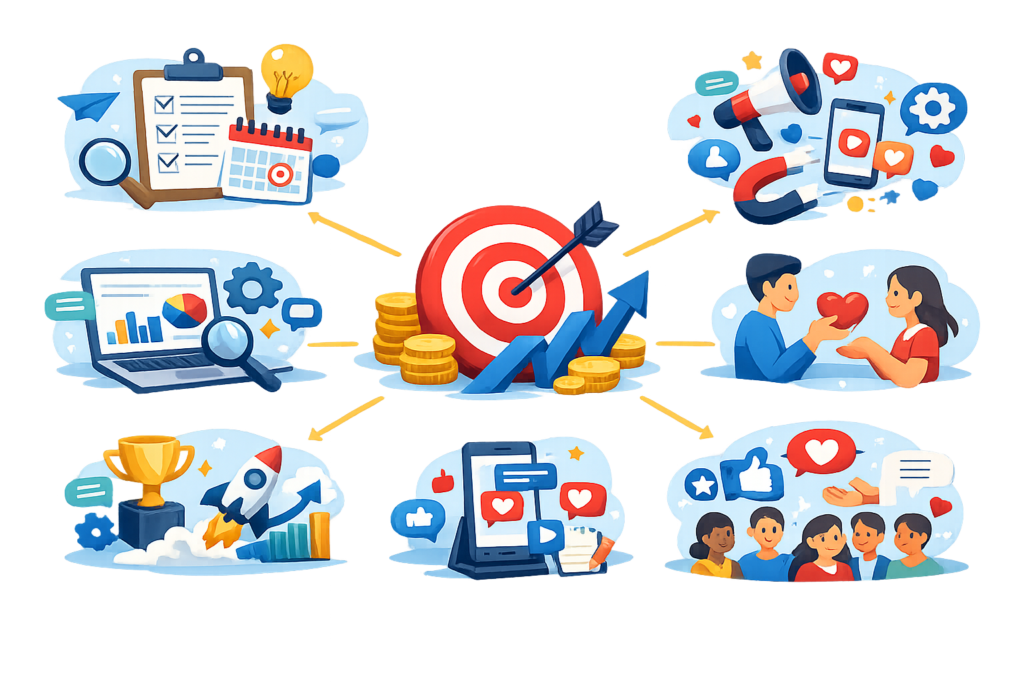
Long-term success in Social Media Marketing depends on consistency, strategic planning, continuous learning, and a genuine commitment to serving customer needs. Businesses that approach social media as an ongoing relationship-building process rather than a collection of isolated campaigns often achieve stronger customer loyalty, improved brand recognition, and sustainable business growth.
The first best practice is developing a comprehensive strategy before publishing content. Every campaign should begin with clearly defined objectives, audience research, platform selection, content planning, performance metrics, and optimization processes. Strategic planning ensures marketing efforts contribute directly to broader business goals rather than generating isolated engagement without measurable outcomes.
Content quality should always take priority over publishing frequency. Valuable educational resources, practical advice, customer success stories, industry insights, visual storytelling, and authentic interactions consistently outperform excessive promotional messaging. Businesses should create content that answers customer questions, solves real problems, and demonstrates expertise while maintaining an approachable communication style.
Consistency remains essential across every aspect of social media marketing. Publishing schedules, visual branding, messaging, customer interactions, and overall brand voice should remain recognizable regardless of the platform being used. Consistent experiences strengthen customer trust while reinforcing long-term brand recognition.
Data-driven decision-making should guide every stage of campaign development. Businesses should regularly analyze audience engagement, advertising performance, conversion rates, customer feedback, and website analytics to identify improvement opportunities. Continuous testing enables marketers to refine strategies based on measurable evidence rather than assumptions.
Organizations should also prioritize accessibility and inclusivity by creating content that accommodates diverse audiences. Clear language, readable formatting, captions for videos, descriptive alternative text for images, and mobile-friendly content improve user experiences while expanding audience reach.
Finally, successful Social Media Marketing requires adaptability. Platform algorithms, customer expectations, industry trends, and digital technologies continue to evolve rapidly. Businesses that remain committed to ongoing learning, experimentation, and responsible innovation are better positioned to maintain competitive advantages while delivering lasting value to their audiences.
Frequently Asked Questions
1. What is Social Media Marketing, and why is it important for businesses?
Social Media Marketing is the process of using social networking platforms to promote products, services, and brands while building meaningful relationships with customers. It includes creating valuable content, engaging with audiences, running advertising campaigns, analyzing performance, and improving customer experiences.
It is important because it helps businesses increase brand awareness, generate qualified leads, improve customer loyalty, drive website traffic, and support long-term business growth. A well-planned strategy also provides measurable insights that help organizations continuously improve their marketing efforts.
2. Which social media platform is best for business marketing?
There is no single platform that works best for every business. The ideal choice depends on your target audience, industry, products, and marketing objectives.
Business-to-business organizations often benefit from professional networking platforms, while consumer-focused brands may achieve stronger engagement through visual and video-based platforms. Instead of trying to manage every platform, businesses should focus on the channels where their ideal customers are most active.
3. How often should businesses post on social media?
Consistency is far more important than publishing large amounts of content. Businesses should establish a realistic content schedule that they can maintain over time without sacrificing quality.
Many successful organizations publish several times each week while ensuring every post provides value, answers customer questions, or supports business goals. Regular performance analysis should guide future publishing frequency based on audience engagement.
4. Is organic Social Media Marketing enough, or should businesses invest in paid advertising?
Organic marketing is excellent for building trust, creating long-term relationships, and strengthening brand authority. However, paid advertising helps businesses reach highly targeted audiences more quickly and generate measurable leads or sales.
The most effective approach combines both strategies. Organic content nurtures customer relationships, while paid campaigns expand reach and accelerate business growth.
5. How can businesses measure Social Media Marketing success?
Success should be measured using meaningful business metrics rather than follower counts alone.
Important performance indicators include:
- Engagement rate
- Website traffic
- Lead generation
- Conversion rate
- Customer acquisition cost
- Return on advertising investment
- Audience growth
- Customer retention
Monitoring these metrics regularly helps businesses optimize future campaigns.
6. What types of content perform best on social media?
High-performing content typically focuses on helping the audience rather than constantly selling products.
Examples include:
- Educational guides
- Industry insights
- Short-form videos
- Customer success stories
- Product demonstrations
- Frequently asked questions
- Behind-the-scenes content
- Infographics
- Interactive polls
- User-generated content
Creating valuable and informative content consistently encourages higher engagement and stronger customer trust.
7. What are the biggest mistakes businesses make with Social Media Marketing?
Common mistakes include:
- Posting without a strategy
- Ignoring audience engagement
- Publishing overly promotional content
- Inconsistent branding
- Neglecting analytics
- Targeting the wrong audience
- Infrequent posting
- Failing to optimize campaigns
Avoiding these issues significantly improves long-term marketing performance.
8. How long does it take to see results from Social Media Marketing?
Results vary depending on industry competition, marketing goals, advertising investment, and content quality.
Paid advertising can generate results within days or weeks, while organic growth generally requires several months of consistent effort. Businesses that remain committed to continuous optimization often experience sustainable improvements in engagement, lead generation, and customer loyalty over time.
Conclusion
Social Media Marketing has become one of the most valuable digital marketing channels available to modern businesses. It offers opportunities to increase visibility, build meaningful customer relationships, generate qualified leads, strengthen brand credibility, and achieve measurable business growth. Success, however, depends on far more than simply publishing regular posts. It requires strategic planning, audience research, valuable content creation, continuous optimization, performance analysis, and a commitment to delivering genuine value.
Businesses that combine organic engagement with targeted advertising, maintain consistent branding, analyze performance data, and adapt to changing digital trends are better positioned to achieve sustainable long-term success. By implementing the strategies discussed throughout this guide, organizations can build stronger online communities while supporting broader marketing and business objectives.
At Appledew UK, we believe successful Social Media Marketing is built on expertise, creativity, transparency, and measurable results. A well-executed strategy not only increases online visibility but also establishes lasting customer trust and long-term business growth.
Want to Implement This Easily?
Prompt
You are an expert consultant. Based on the blog post titled “Social Media Marketing”, provide a step-by-step, practical implementation guide. Include tools, best practices, common mistakes to avoid, and advanced tips. Assume the reader wants to implement everything discussed in this article effectively.
Call to Action
Want our help implementing this? Just reach out to us via our website contact form: