

Introduction: Why Social Media Marketing Matters More Than Ever
Social Media Marketing has become one of the most powerful digital growth channels for modern businesses. From building brand awareness to generating qualified leads and driving conversions, social platforms now influence nearly every stage of the customer journey. Consumers no longer rely only on websites or search engines — they actively discover, evaluate, and engage with brands across social networks before making purchasing decisions.
In the UK, social media usage continues to rise year after year. According to the Ofcom Online Nation 2024 report, social platforms play a central role in how people research products, follow businesses, and interact with brands online. This shift makes social media marketing a critical component of any successful digital strategy.
At Appledew UK, we understand that effective social media marketing goes far beyond posting content. It requires a structured strategy, platform-specific expertise, high-quality creatives, and continuous performance optimisation. Businesses that approach social media with clear goals, consistent messaging, and data-backed decisions are far more likely to see long-term returns.
Industry research from HubSpot’s State of Marketing Report shows that social media consistently ranks among the top channels for lead generation and customer engagement. Meanwhile, insights from Hootsuite Social Media Trends highlight the growing importance of short-form video, authenticity, and community-driven content.
In this guide, we break down everything you need to know about social media marketing — from strategy and platform selection to content creation, paid advertising, and performance measurement — helping businesses make informed, results-driven decisions.
What Is Social Media Marketing?
Social media marketing (SMM) is a powerful digital strategy that leverages platforms like Facebook, Instagram, Twitter, LinkedIn, and TikTok to promote businesses, products, and services. It focuses on creating engaging content, building brand awareness, and fostering meaningful connections with your target audience. Through social media marketing, businesses can reach millions of potential customers, drive website traffic, generate leads, and increase conversions. By strategically planning posts, advertisements, and interactive campaigns, brands can stay relevant in today’s competitive online landscape.
Effective social media marketing also includes monitoring analytics, understanding audience behavior, and optimizing campaigns to maximize ROI. With SEO integration, social media content can improve search engine rankings, boost online visibility, and strengthen brand authority. For modern businesses, adopting a robust social media marketing strategy is essential to build loyalty, expand reach, and achieve sustainable growth in the digital era.
It includes:
- Organic content creation
- Community engagement
- Paid social advertising
- Influencer collaboration
- Analytics and performance tracking
Modern social media marketing is data-driven, customer-focused, and content-led, not random posting.
Why Social Media Marketing Is Essential for Business Growth

1. Brand Awareness at Scale
Social platforms allow brands to reach thousands of users organically and millions through paid campaigns. Industry data from Hootsuite Social Media Trends confirms that businesses with consistent posting schedules experience significantly higher brand recall.
2. Trust & Credibility Building
Customers trust brands that communicate openly, respond quickly, and share valuable insights. Social proof such as reviews, testimonials, and user-generated content builds authenticity faster than traditional advertising.
3. Direct Customer Engagement
Unlike static websites, social media enables two-way conversations. This interaction improves customer satisfaction and strengthens brand loyalty.
4. Sales & Lead Generation
Platforms now support advanced conversion tools. Research from HubSpot’s State of Marketing Report highlights social media as a top lead-generation channel for both B2B and B2C brands.
Building a Winning Social Media Strategy
Step 1: Define Clear Goals & KPIs
Start by identifying business-focused objectives:
- Brand awareness
- Website traffic
- Lead generation
- Online sales
- Customer retention
Each goal must align with measurable KPIs such as reach, engagement rate, click-through rate (CTR), conversions, and cost per acquisition (CPA).
Best practice frameworks are outlined by HubSpot Marketing Statistics and should be followed to ensure accurate tracking.
Step 2: Understand Your Target Audience
Successful social strategies begin with deep audience insights:
- Age, location, and interests
- Preferred platforms
- Pain points and motivations
- Buying behaviour
Audience research should be validated using platform insights and national digital usage data like Ofcom’s Online Behaviour Research.
Step 3: Choose the Right Social Media Platforms
Not all platforms deliver equal value. Focus where your audience spends time.
Facebook & Instagram
Ideal for local services, ecommerce, and lifestyle brands.
LinkedIn
Best for B2B, recruitment, professional services, and SaaS companies.
TikTok
High discovery potential and strong engagement, especially for short-form video.
X (Twitter)
Effective for thought leadership, trends, and brand conversation.
According to HubSpot’s Fastest-Growing Platforms Report, short-form video platforms continue to dominate user attention.
Content Strategy: What to Post & Why It Works
Content Pillars That Convert
High-performing brands organise content into clear pillars:
- Educational tips & guides
- Product or service highlights
- Customer testimonials & case studies
- Behind-the-scenes content
- Promotional offers
Video Is No Longer Optional
Short-form video drives the highest engagement. Meta confirms this in Meta Business Help – Reels Best Practices, recommending vertical, authentic, value-led video formats.
Content Calendar & Posting Frequency
Consistency matters more than volume.
Recommended cadence for SMEs:
- 3–5 posts per week per platform
- 1–2 short videos weekly
- Daily story updates (Instagram/Facebook)
A structured calendar ensures consistent messaging and efficient content creation.
Paid Social Media Advertising: When & How to Scale
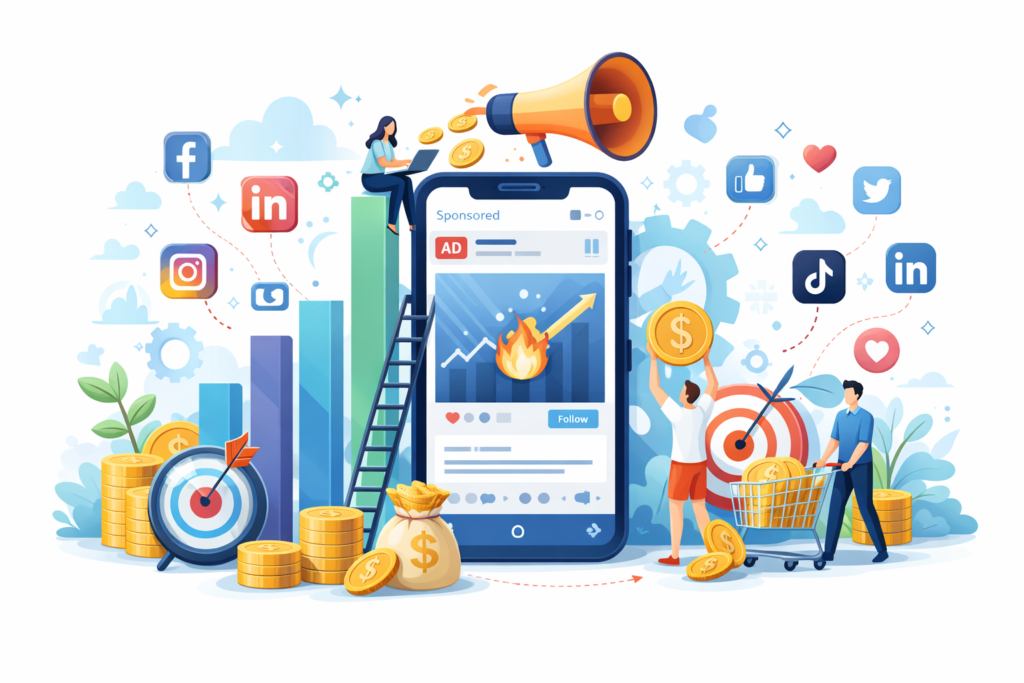
Paid social media advertising is a strategic way to amplify your brand’s reach, drive targeted traffic, and generate high-quality leads through platforms like Facebook, Instagram, LinkedIn, and TikTok. By investing in paid campaigns, businesses can reach specific audiences based on demographics, interests, and online behavior. Knowing when to start paid advertising is crucial—typically after building organic engagement and understanding your audience’s preferences.
Scaling paid social media campaigns requires careful monitoring of performance metrics, A/B testing, and optimizing ad spend to maximize ROI. With proper strategies, businesses can expand their reach, boost conversions, and strengthen brand authority. Implementing paid social campaigns alongside organic efforts ensures sustainable growth and long-term online visibility.
Best Paid Social Formats:
- Lead generation ads
- Conversion campaigns
- Retargeting ads
- Lookalike audiences
According to Meta Ad Delivery Best Practices, campaigns should reach at least 50 conversions per ad set to exit the learning phase efficiently.
Measuring Social Media Success Properly
Measuring social media success properly is essential for understanding the effectiveness of your digital marketing strategies. By tracking key performance indicators (KPIs) such as engagement rate, reach, impressions, click-through rate, and conversions, businesses can evaluate which campaigns resonate most with their target audience. Proper measurement helps identify strengths, weaknesses, and areas for improvement, ensuring resources are allocated efficiently for maximum impact.
Using analytics tools like Facebook Insights, Instagram Analytics, and Google Analytics allows marketers to gain actionable insights and make data-driven decisions. Consistently monitoring and analyzing social media performance not only improves ROI but also strengthens brand visibility and customer engagement. A structured approach to measuring success ensures sustainable growth in today’s competitive digital landscape.
Key Metrics to Monitor:
- Engagement rate
- Click-through rate (CTR)
- Conversion rate
- Cost per lead (CPL)
- Return on ad spend (ROAS)
Use GA4, Meta Pixel, and server-side tracking to gain accurate attribution insights. Measurement frameworks are reinforced in HubSpot Analytics Guidance.
Common Social Media Marketing Mistakes to Avoid
Not Measuring or Optimising Performance
Without tracking performance data, businesses cannot improve results. Regular analysis and optimisation are necessary to refine content, ads, and messaging.
Posting Without a Strategy
Many businesses publish content randomly without defined goals, content pillars, or KPIs. This leads to inconsistent messaging and poor performance. A documented strategy ensures every post supports a clear business objective.
Focusing on Vanity Metrics Only
Likes and followers look impressive but do not always translate into revenue. Businesses should prioritise engagement quality, conversions, and lead data instead of surface-level metrics.
Ignoring Audience Insights
Failing to analyse audience behaviour, preferences, and platform analytics results in irrelevant content. Understanding when and how audiences engage is essential for sustained growth.
Over-Automation and Low-Quality AI Content
Excessive automation and unedited AI-generated posts reduce authenticity and trust. Social platforms and search engines reward original, experience-driven content over mass-produced posts.
Being Active on Too Many Platforms
Trying to maintain every social channel spreads resources thin. It is more effective to focus on one or two platforms where your audience is most active and grow from there.
Inconsistent Posting and Engagement
Irregular posting and slow responses to comments or messages damage brand credibility. Consistency builds familiarity and algorithm visibility.
Advanced Social Media Growth Techniques

Advanced social media growth techniques help businesses expand their online presence, increase engagement, and attract high-quality followers. These strategies go beyond basic posting and include leveraging influencer collaborations, creating viral content, using targeted advertising, and optimizing posting schedules. By implementing these methods, brands can reach larger audiences, strengthen their digital footprint, and improve overall social media performance.
In addition, analyzing audience behavior, monitoring trends, and utilizing social media analytics tools are key components of advanced growth strategies. Techniques such as retargeting campaigns, cross-platform promotion, and interactive content like polls and live videos can significantly boost engagement and conversions. Adopting these advanced social media growth methods ensures sustainable brand growth and long-term online success.
- Repurpose long-form blogs into short videos
- Use UGC (user-generated content) in ads
- Test influencer micro-collaborations
- Combine AI tools with human editing for content creation
Marketing leaders recommend a balanced AI + human approach, as outlined in HubSpot’s AI Marketing Guide.
Real-World Use Case Example
A UK-based service company implemented a structured social strategy combining educational Reels, customer testimonials, and lead ads. Within 8 weeks, they achieved:
- 40% increase in inbound leads
- Reduced cost per lead
- Stronger brand visibility locally
This demonstrates how strategy-driven social marketing delivers tangible ROI.
Frequently Asked Questions
Q1. What is social media marketing and why is it important for businesses?
Social media marketing is the use of platforms like Facebook, Instagram, LinkedIn, TikTok, and X to promote a brand, engage audiences, and drive measurable outcomes such as leads and sales. It is important because customers actively research, compare, and interact with brands on social platforms before making buying decisions.
Q2. How often should a business post on social media?
For most small and medium-sized businesses, posting 3–5 times per week per platform is ideal. Consistency is more important than volume. A regular posting schedule helps maintain visibility, engagement, and algorithm favourability.
Q3. Which social media platform delivers the best ROI?
There is no single best platform for every business. LinkedIn typically performs best for B2B companies, while Facebook, Instagram, and TikTok deliver strong results for B2C and local service-based businesses. ROI depends on audience behaviour and campaign goals.
Q4. Is paid social media advertising necessary?
Paid social is not mandatory, but it significantly accelerates results. Organic content builds trust and brand authority, while paid ads increase reach, drive targeted traffic, and generate leads faster. A balanced mix of both produces the strongest outcomes.
Q5. How long does social media marketing take to show results?
Organic growth usually takes 3–6 months to show consistent engagement and leads. Paid social campaigns can deliver results within 2–4 weeks, depending on budget, targeting, and creative quality.
Q6. What type of content performs best on social media?
Short-form video, educational posts, customer testimonials, and behind-the-scenes content perform exceptionally well. Platforms currently prioritise authentic, value-driven content over overly polished promotional posts.
Q7. Can social media marketing help with lead generation?
Yes. Social media is a powerful lead-generation channel when combined with strong calls-to-action, landing pages, and lead ads. Platforms like Meta and LinkedIn offer advanced targeting options to reach high-intent audiences.
Q8. How do businesses measure social media marketing success?
Success is measured using KPIs such as engagement rate, click-through rate (CTR), conversions, cost per lead (CPL), and return on ad spend (ROAS). Tools like GA4 and platform analytics provide accurate performance insights.
Q9. Is AI useful for social media content creation?
AI can support content ideation, captions, and scheduling, but human editing is essential. Businesses should use AI as a productivity tool while ensuring originality, brand voice, and compliance with quality guidelines.
Q10. Should small businesses outsource social media marketing?
Outsourcing is often cost-effective for small businesses. Professional agencies bring strategy, consistency, platform expertise, and analytics knowledge that are difficult to manage in-house without dedicated resources.
Conclusion: Turning Social Media Into a Revenue Channel
Social media marketing is no longer optional for businesses that want to remain competitive in an increasingly digital world. When executed strategically, it becomes a powerful engine for brand visibility, customer engagement, and sustainable revenue growth. The key is moving beyond random posting and focusing on a clear plan built around audience insight, consistent content, and measurable objectives.
Throughout this guide, we’ve explored how businesses can use social media to build trust, generate leads, and support long-term growth. By selecting the right platforms, creating value-driven content, leveraging paid social responsibly, and tracking meaningful performance metrics, brands can turn social media into a reliable marketing channel rather than a time-consuming experiment.
At Appledew UK, we believe that successful social media marketing combines creativity with data. Insights from trusted sources such as Meta Business Help and HubSpot Marketing Analytics reinforce the importance of testing, optimisation, and audience-first thinking. Businesses that continuously refine their approach based on real data consistently outperform those that rely on guesswork.
It’s also important to remember that quality matters more than quantity. Platforms and search engines increasingly reward original, experience-led content that genuinely helps users. Avoiding common mistakes — such as over-automation, poor measurement, or inconsistent engagement — ensures your social presence supports both brand credibility and search visibility.
Whether you are just starting or looking to scale your existing efforts, a well-planned social media strategy can deliver measurable results. With the right expertise, tools, and ongoing optimisation, social media can become one of the most valuable assets in your digital marketing ecosystem.
AI Implementation Prompt for Social Media Marketing Blog Post:
Prompt for AI or Marketing Teams:
Using the content in this blog post, create a complete social media marketing implementation plan for a modern business. Follow these steps carefully:
- Business Goals & KPIs
- Identify business objectives (e.g., brand awareness, lead generation, sales).
- Suggest measurable KPIs aligned with each goal (e.g., CTR, ROAS, engagement rate).
- Audience Analysis
- Define the target audience (age, location, interests, pain points).
- Identify the best social platforms for this audience.
- Platform Strategy
- Recommend which platforms to focus on (Facebook, Instagram, TikTok, LinkedIn, X).
- Include platform-specific content strategies and posting frequencies.
- Content Planning
- Create content pillars (educational posts, product highlights, testimonials, behind-the-scenes, promotional).
- Suggest short-form video topics and formats.
- Create a sample content calendar for at least 4 weeks.
- Paid Advertising Strategy
- Recommend when and how to start paid campaigns.
- Suggest ad types (lead generation, retargeting, conversion campaigns).
- Include budget allocation, targeting options, and A/B testing suggestions.
- Measurement & Optimization
- List key metrics to track (engagement rate, CTR, conversion rate, CPL, ROAS).
- Suggest analytics tools and reporting frequency.
- Include strategies for continuous improvement based on data.
- Avoid Common Mistakes
- Incorporate checks to avoid random posting, over-automation, low-quality AI content, vanity-metric focus, and inconsistent engagement.
- Advanced Growth Techniques
- Include influencer collaborations, repurposing content, UGC in ads, and interactive content like polls and live videos.
- Suggest a balance between AI-supported content creation and human editing.
- Example Implementation
- Provide a sample 4-week campaign showing content types, post formats, posting schedule, ad campaigns, and expected results.
- Compliance with Search Quality Guidelines
- Ensure all content recommendations align with Google’s Search Quality Guidelines for originality, user experience, and authenticity.
Goal: Deliver a structured, actionable social media marketing plan that can be implemented immediately by a business or marketing team. Include timelines, content ideas, and KPIs to track success.
For further assistance implementing this plan, reach out via our [website contact form](https://appledew.co.uk/contact-us/).