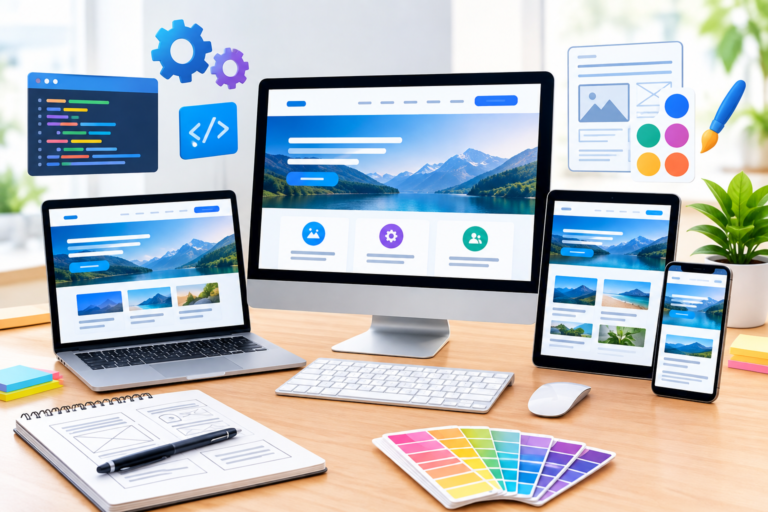
Discover everything you need to know about Website Design and Development, including responsive design, UX, SEO, website security, performance optimisation, and modern development practices to build a website that attracts visitors and converts them into loyal customers.
Introduction
A professional website is no longer just an online brochure—it is the digital foundation of your business. Whether you operate a local company, an eCommerce store, a professional service, or an international brand, your website influences how customers perceive your credibility, interact with your products or services, and ultimately decide whether to do business with you.
Modern Website Design and Development combines creativity, technology, user experience, and strategic planning to create websites that are visually appealing, technically sound, and designed to achieve measurable business objectives. A successful website should be fast, secure, responsive across all devices, easy to navigate, and optimised for both search engines and users.
At Appledew UK, we understand that every business has unique goals. An effective website is built by combining thoughtful design, robust development practices, search engine optimisation, accessibility, and continuous performance improvements. Rather than focusing solely on appearance, successful websites prioritise functionality, usability, and long-term scalability.
This comprehensive guide explores every essential aspect of Website Design and Development—from planning and user experience to SEO, performance optimisation, security, maintenance, and future trends. Whether you are creating your first website or redesigning an existing one, this guide will help you make informed decisions that support sustainable online growth.
What Is Website Design and Development?
Website Design and Development refers to the complete process of planning, designing, building, launching, and maintaining websites that effectively serve users while supporting business objectives. Although these two disciplines often work together, they focus on different aspects of creating a successful online presence.
Website design concentrates on the visual appearance and user experience. Designers carefully choose layouts, colour palettes, typography, imagery, spacing, navigation structures, and interactive elements that guide visitors naturally through the website. Great design is not simply about making a website attractive; it ensures users can easily find information, complete actions, and enjoy a seamless browsing experience. Every design decision should improve clarity, accessibility, and engagement while reinforcing the organisation’s brand identity.
Website development transforms those visual concepts into fully functional websites using modern programming languages, frameworks, databases, and content management systems. Developers ensure pages load efficiently, forms function correctly, content displays consistently across different devices, and security measures protect user information. Front-end development focuses on everything users interact with directly, while back-end development manages servers, databases, application logic, and integrations that power website functionality behind the scenes.
The most successful websites combine exceptional design with reliable development. Beautiful visuals alone cannot compensate for slow loading speeds or technical issues, just as robust functionality cannot overcome confusing navigation or poor usability. Businesses that invest in both areas create websites that attract visitors, build trust, encourage conversions, and support long-term digital marketing success.
Why Professional Website Design Matters for Business Success
A professionally designed website often serves as the first impression potential customers have of a business. Research consistently shows that visitors form opinions about a website within seconds of arriving. During this brief period, they evaluate professionalism, credibility, ease of use, and overall trustworthiness. A well-designed website immediately communicates quality and encourages visitors to continue exploring.
Professional design also improves user engagement. Clear navigation, intuitive layouts, readable typography, and strategically placed calls-to-action help visitors accomplish their goals quickly. Whether users want to purchase products, request quotations, book appointments, or learn about services, effective design removes unnecessary obstacles and simplifies their journey. This results in lower bounce rates, increased session durations, and higher conversion rates.
Beyond user experience, professional website design directly supports digital marketing efforts. Search engine optimisation, content marketing, paid advertising, email campaigns, and social media promotions all direct visitors to your website. If visitors encounter outdated visuals, inconsistent branding, broken layouts, or confusing navigation, valuable marketing investments may be wasted. A professionally website design maximises the effectiveness of every digital marketing channel by providing a consistent, trustworthy destination where visitors feel confident taking action.
Furthermore, professional design contributes to long-term business growth. As customer expectations continue evolving, businesses require websites that adapt to changing technologies, expanding content, and new marketing strategies without requiring complete redevelopment every few years.
Planning Your Website Before Development Begins
Successful websites rarely happen by accident. They begin with comprehensive planning that aligns business objectives, user needs, technical requirements, and marketing strategies before development starts. Investing time in planning reduces costly revisions and ensures every component serves a meaningful purpose.
The planning stage begins by clearly defining business goals. Different websites have different priorities. An eCommerce website aims to maximise online sales, while a law firm’s website may focus on consultation requests. Educational institutions prioritise information accessibility, whereas software companies may emphasise product demonstrations and lead generation. Understanding these objectives helps determine content structure, functionality, navigation, and conversion pathways.
Audience research is equally important. Businesses should identify their ideal customers, understand user behaviour, analyse common pain points, and determine how visitors are likely to interact with the website. Personas, customer journey mapping, and competitor analysis provide valuable insights that influence design decisions. Rather than designing for everyone, successful websites focus on the needs of clearly defined target audiences.
Website planning also includes sitemap creation, content planning, feature prioritisation, technical requirements, and SEO strategy. Organising pages logically improves navigation while helping search engines understand website structure. Planning internal linking opportunities, content categories, metadata, and keyword targeting before development begins creates a stronger foundation for future organic growth.
A carefully planned website typically launches faster, performs better, requires fewer revisions, and delivers greater long-term value compared to projects that begin without a structured strategy.
Understanding User Experience (UX) and User Interface (UI)
User Experience (UX) and User Interface (UI) are closely related but distinct disciplines that significantly influence website success. Together they determine how visitors interact with a website and how they feel throughout that experience.
User Experience focuses on usability, accessibility, efficiency, and satisfaction. UX designers study user behaviour to create logical navigation structures, intuitive workflows, and frictionless interactions. Every page should help visitors accomplish tasks quickly without confusion. Effective UX considers loading speed, readability, mobile responsiveness, accessibility, search functionality, form design, and content hierarchy to create enjoyable experiences.
User Interface concentrates on the visual presentation of interactive elements. Buttons, menus, forms, icons, typography, colour schemes, spacing, animations, and layout consistency all contribute to UI design. Good interfaces guide users naturally while reinforcing brand identity. Poor interface design can overwhelm visitors, increase frustration, and reduce conversions even when the underlying functionality works perfectly.
Successful websites balance aesthetics with functionality. Attractive visuals should never compromise usability, while efficient functionality should maintain visual consistency and professionalism. Modern design practices emphasise simplicity, clarity, and accessibility rather than excessive animations or unnecessary visual complexity.
Regular usability testing provides valuable feedback about navigation issues, confusing layouts, and potential improvements. Observing real users interacting with the website often reveals opportunities that internal teams may overlook. Continuous UX and UI optimisation helps businesses adapt to changing customer expectations while improving overall website performance.
Responsive Web Design: Meeting the Needs of Every Device
Internet users now access websites from smartphones, tablets, laptops, desktop computers, smart televisions, and many other connected devices. Responsive web design ensures websites automatically adapt to different screen sizes without sacrificing usability or visual quality.
Responsive design relies on flexible layouts, scalable images, adaptive typography, and media queries that adjust content presentation according to screen dimensions. Rather than building separate desktop and mobile websites, responsive development creates one adaptable website capable of serving every visitor consistently.
Mobile responsiveness has become increasingly important because search engines prioritise mobile-friendly experiences when ranking websites. Visitors also expect websites to function seamlessly regardless of device. Difficult navigation, tiny text, overlapping elements, or slow mobile performance frequently cause users to abandon websites before completing desired actions.
Responsive design also supports accessibility by improving readability, touch interactions, and navigation across various devices. Larger buttons, simplified menus, optimised images, and appropriate spacing make websites easier to use for diverse audiences. Businesses benefit from broader reach, improved customer satisfaction, higher search visibility, and increased conversion opportunities.
Developers should thoroughly test websites across multiple browsers, operating systems, screen sizes, and devices throughout development. Continuous testing helps identify compatibility issues before launch, ensuring every visitor receives a consistent, high-quality experience regardless of how they access the website.
Essential Elements of High-Converting Website Design
A visually attractive website alone does not guarantee business success. High-converting websites are intentionally designed to guide visitors toward meaningful actions such as making purchases, requesting consultations, subscribing to newsletters, or contacting the business. Every design element should support these objectives while maintaining an engaging user experience.
Clear navigation forms the foundation of an effective website. Visitors should immediately understand where they are, what information is available, and how to reach important pages. Simple menus, logical page hierarchies, descriptive labels, and strategically placed search functionality reduce frustration and encourage deeper exploration. Consistent navigation across every page builds familiarity and confidence, making users more likely to continue interacting with the website rather than leaving after viewing a single page.
Compelling calls-to-action (CTAs) also play a critical role in improving conversions. Buttons encouraging users to Request a Quote, Book a Consultation, Download a Guide, or Contact Our Team should stand out visually without overwhelming the page. Effective CTAs use action-oriented language, appear at natural decision points, and align with visitor intent. Supporting elements such as customer testimonials, trust badges, client logos, case studies, guarantees, and transparent contact information reinforce credibility and reduce hesitation.
Content presentation is equally important. Well-structured headings, concise paragraphs, meaningful imagery, whitespace, and readable typography help visitors absorb information efficiently. High-quality visuals should complement the written content rather than distract from it. Combining thoughtful design with persuasive messaging creates websites that not only attract visitors but also encourage them to take measurable actions that support business growth.
Website Development Technologies: Choosing the Right Foundation
Website development technologies have evolved significantly over the past decade, enabling businesses to create faster, more secure, and highly interactive websites. Choosing the right technology stack is one of the most important decisions during a website project because it affects scalability, security, performance, maintenance, and future expansion. Rather than selecting technologies based solely on popularity, organisations should consider business objectives, technical requirements, budget, and long-term growth plans.
Front-end development focuses on everything visitors see and interact with. Modern technologies such as HTML5, CSS3, and JavaScript provide the foundation for responsive, interactive websites. Popular JavaScript frameworks help developers create dynamic user experiences while maintaining high performance. Clean front-end code ensures pages load efficiently, display consistently across browsers, and provide smooth interactions on desktop and mobile devices alike. Developers should also prioritise semantic coding practices that improve accessibility and search engine understanding.
Back-end development powers the functionality users cannot see directly. It manages databases, authentication systems, content management, server communication, APIs, and business logic. Depending on project requirements, developers may use PHP, Python, Node.js, or other programming languages to build reliable applications. The back-end should be designed with scalability in mind, allowing the website to handle increasing traffic without sacrificing performance. Regular updates, code reviews, and testing contribute to long-term reliability while reducing technical debt that could create future maintenance challenges.
Choosing the Right Content Management System (CMS)
A Content Management System (CMS) allows businesses to create, update, and manage website content without requiring advanced programming knowledge. Selecting the appropriate CMS can significantly influence workflow efficiency, website flexibility, and ongoing maintenance costs. The ideal platform depends on factors such as business size, technical expertise, content volume, custom functionality, and future growth.
Many organisations choose a CMS because it simplifies content publishing. Marketing teams can update blogs, landing pages, product descriptions, and multimedia content without relying on developers for every change. This flexibility supports faster marketing campaigns and enables businesses to keep information current. A good CMS also provides user role management, allowing administrators, editors, authors, and contributors to collaborate securely within clearly defined permissions.
Scalability is another important consideration. Businesses should evaluate whether the CMS can accommodate future expansion, including multilingual content, eCommerce functionality, membership portals, booking systems, or customer portals. Compatibility with third-party integrations, SEO tools, analytics platforms, and security plugins also contributes to long-term success. Selecting a well-supported CMS with an active development community ensures access to regular updates, documentation, and security improvements that help maintain website stability over time.
Website Speed and Performance Optimisation
Website speed has become one of the most influential factors affecting user experience, conversion rates, and search visibility. Visitors expect pages to load almost instantly, and even small delays can increase bounce rates while reducing customer satisfaction. Performance optimisation should therefore be integrated throughout the design and development process rather than treated as an afterthought after launch.
Several factors influence loading speed, including image optimisation, server response time, browser caching, code efficiency, database performance, and content delivery strategies. Compressing images without sacrificing quality significantly reduces page weight, while minimising CSS and JavaScript files decreases loading times. Efficient hosting infrastructure, modern caching techniques, and Content Delivery Networks (CDNs) further improve website responsiveness for visitors across different geographical locations.
Performance monitoring should continue long after launch. Regular audits identify bottlenecks that emerge as websites grow through additional content, plugins, integrations, and traffic. Businesses that consistently monitor website performance can proactively resolve issues before they negatively affect users or search rankings. Faster websites generally experience higher engagement, longer session durations, improved conversion rates, and stronger overall customer satisfaction.
Useful technical guidance can be found through Google PageSpeed Insights.
Website Security Best Practices
Website security protects businesses, customers, and sensitive information from cyber threats that continue becoming more sophisticated each year. Security should never be viewed as an optional feature; instead, it should be integrated into every stage of website planning, development, deployment, and maintenance.
One of the most fundamental security measures involves implementing HTTPS through an SSL/TLS certificate, encrypting communication between users and servers. Strong password policies, multi-factor authentication, secure hosting environments, and regular software updates further reduce vulnerability to attacks. Businesses should also minimise unnecessary plugins, remove outdated software, and regularly review user permissions to reduce potential security risks.
Routine security monitoring plays an equally important role. Automated backups ensure data can be restored quickly if problems occur, while malware scanning identifies suspicious activity before significant damage develops. Firewalls, intrusion detection systems, and continuous vulnerability assessments strengthen website resilience against common attack methods such as SQL injection, cross-site scripting, and brute-force login attempts. Security is an ongoing responsibility rather than a one-time setup, requiring consistent attention throughout the website’s lifecycle.
Useful resources:
SEO-Friendly Website Development
Search engine optimisation begins during website development rather than after launch. Technical SEO provides the foundation that enables search engines to crawl, understand, and index website content efficiently. Developers and designers should collaborate closely with SEO specialists to ensure every technical decision supports long-term organic visibility.
Clean code structure improves crawlability while semantic HTML helps search engines understand page hierarchy. Logical URL structures, descriptive title tags, meta descriptions, structured headings, XML sitemaps, and robots.txt configuration all contribute to better indexing. Internal linking distributes authority throughout the website while helping visitors discover related content naturally. Image optimisation, descriptive alt text, and schema markup further enhance search visibility while improving accessibility.
Technical performance also affects SEO success. Mobile responsiveness, Core Web Vitals, secure HTTPS connections, fast loading speeds, and accessibility standards all influence search rankings. Businesses that integrate SEO best practices throughout development avoid many costly technical issues that often require extensive revisions after launch. A technically sound website provides a stronger foundation for content marketing, link building, and ongoing organic growth.
Useful references:
Accessibility: Designing Websites for Everyone
Accessibility ensures websites remain usable by individuals with diverse abilities, including people who rely on assistive technologies such as screen readers, keyboard navigation, magnifiers, or voice input systems. Inclusive design benefits everyone by improving clarity, usability, and overall user experience.
Accessible websites use meaningful headings, descriptive alternative text for images, sufficient colour contrast, logical keyboard navigation, readable typography, and properly labelled form fields. Interactive elements should remain accessible without requiring a mouse, while multimedia content should include captions or transcripts whenever appropriate. These improvements not only support users with disabilities but also enhance usability across mobile devices and varying internet conditions.
Accessibility is increasingly recognised as both an ethical responsibility and a legal consideration in many regions. Designing with accessibility in mind demonstrates commitment to serving broader audiences while reducing barriers that might otherwise prevent potential customers from engaging with the business. Regular accessibility audits and user testing help identify opportunities for continuous improvement.
Accessibility guidelines:
Web Content Accessibility Guidelines (WCAG)
Website Maintenance and Continuous Improvement
Launching a website represents the beginning rather than the end of its lifecycle. Ongoing maintenance ensures websites remain secure, fast, accurate, and aligned with changing customer expectations. Without regular updates, even professionally developed websites gradually experience declining performance, outdated content, security vulnerabilities, and compatibility issues.
Routine maintenance includes software updates, plugin management, database optimisation, broken link monitoring, content reviews, backup verification, uptime monitoring, and security scanning. Businesses should establish structured maintenance schedules to ensure every component receives appropriate attention. Monitoring analytics also provides valuable insights into visitor behaviour, helping identify opportunities for improved navigation, content optimisation, and conversion enhancements.
Continuous improvement encourages organisations to treat websites as evolving digital assets rather than static projects. User feedback, A/B testing, search performance analysis, and technological advancements should inform ongoing enhancements. Businesses that regularly refine their websites remain competitive, improve customer satisfaction, and maximise return on investment from their digital presence over the long term.
Future Trends in Website Design and Development
The digital landscape continues to evolve at an extraordinary pace, making it essential for businesses to stay informed about emerging trends in Website Design and Development. While fundamental principles such as usability, performance, and accessibility remain constant, new technologies are reshaping how websites are designed, developed, and experienced. Organisations that embrace innovation strategically are better positioned to meet customer expectations and maintain a competitive advantage.
Artificial intelligence is becoming an increasingly valuable tool in website design. AI-powered chatbots, intelligent search functionality, personalised content recommendations, automated customer support, and predictive analytics help businesses deliver more relevant and engaging user experiences. AI can also assist developers by automating repetitive coding tasks, identifying bugs, and improving testing efficiency. However, AI should complement human expertise rather than replace thoughtful design, strategic planning, and quality assurance.
Another significant trend is the growing adoption of headless architecture, progressive web applications (PWAs), and API-first development. These modern approaches provide greater flexibility, faster performance, and easier integration with multiple digital platforms. Businesses are also placing increased emphasis on sustainability by optimising websites to reduce energy consumption through efficient coding, compressed assets, and streamlined hosting solutions. As customer expectations continue to rise, organisations that invest in scalable technologies, continuous optimisation, and user-centred innovation will remain well positioned for long-term digital success.
Common Mistakes Businesses Make with Website Design and Development
Many businesses invest substantial resources into building websites but unintentionally make decisions that limit long-term success. Recognising these common mistakes early helps organisations avoid unnecessary costs, improve user satisfaction, and maximise return on investment.
One of the most frequent mistakes is prioritising appearance over functionality. A visually impressive website may initially capture attention, but if navigation is confusing, pages load slowly, or essential information is difficult to find, visitors are unlikely to remain engaged. Businesses should remember that design exists to support usability, not distract from it. Every visual element should contribute to a smoother user experience.
Another common issue is neglecting mobile users. With a significant percentage of web traffic coming from smartphones and tablets, failing to optimise for smaller screens can result in lost opportunities and lower search visibility. Likewise, ignoring accessibility excludes potential customers and creates unnecessary barriers for users with disabilities. Businesses should also avoid publishing low-quality content, using outdated plugins, neglecting security updates, or launching websites without comprehensive testing. Regular maintenance, analytics reviews, and user feedback help identify issues before they negatively affect customer experience or business performance.
Best Practices Summary
Building a successful website requires more than attractive visuals or advanced technology. The most effective websites combine strategic planning, user-focused design, reliable development, technical optimisation, and continuous improvement. By following proven best practices, businesses can create websites that support both customer satisfaction and long-term growth.
Start every project with clearly defined objectives and a deep understanding of your target audience. Develop an organised site structure, create valuable content, and ensure every page serves a meaningful purpose. Prioritise responsive design, intuitive navigation, accessibility, and fast loading speeds to provide consistent experiences across all devices. Integrate search engine optimisation throughout the development process rather than treating it as a separate task after launch.
Security, performance monitoring, regular updates, and analytics should remain ongoing priorities throughout the website’s lifecycle. Continually evaluate user behaviour, test improvements, and refine the experience based on data rather than assumptions. Businesses that treat their websites as continuously evolving digital assets are more likely to achieve sustainable online success while adapting effectively to changing technologies and customer expectations.
Frequently Asked Questions
1. What is Website Design and Development?
Website Design and Development is the complete process of planning, designing, building, launching, and maintaining a website. Design focuses on appearance and user experience, while development ensures the website functions correctly, securely, and efficiently.
2. Why is responsive website design important?
Responsive design ensures your website automatically adapts to smartphones, tablets, laptops, and desktop computers. It improves user experience, supports higher search rankings, and helps maximise conversions across all devices.
3. How long does it take to develop a professional website?
The timeline depends on the project’s complexity. A small business website may take several weeks, while larger websites with custom functionality, eCommerce features, or complex integrations may require several months.
4. Why is website speed important?
Fast-loading websites improve user satisfaction, reduce bounce rates, increase conversion rates, and support better search engine rankings. Performance optimisation should be considered throughout development and ongoing maintenance.
5. How often should a website be updated?
Content should be reviewed regularly, while software, plugins, themes, and security patches should be updated whenever new stable versions become available. Regular maintenance helps keep websites secure and performing efficiently.
6. What is the difference between UX and UI?
User Experience (UX) focuses on how users interact with a website and how easy it is to accomplish tasks. User Interface (UI) focuses on the visual appearance, including layouts, buttons, colours, typography, and interactive elements.
7. Does Website Design affect SEO?
Yes. Website design directly influences SEO through mobile responsiveness, page speed, navigation, accessibility, structured content, Core Web Vitals, and user experience. A well-designed website provides a stronger technical foundation for search engine optimisation.
8. Why is website security essential?
Website security protects customer information, business data, and website functionality from cyber threats. Strong security practices build trust while reducing the risk of downtime, data breaches, and reputational damage.
Conclusion
A successful Website Design and Development project combines strategic planning, exceptional design, reliable development, technical optimisation, and ongoing improvement. Businesses that invest in responsive design, user experience, website performance, accessibility, security, and search engine optimisation build digital platforms capable of supporting long-term growth and delivering measurable business results.
At Appledew UK, we believe every business deserves a website that not only looks professional but also performs exceptionally. By following the best practices outlined in this guide and continually refining your website based on user behaviour and technological advancements, you can create an online presence that strengthens your brand, attracts qualified visitors, and converts them into loyal customers.
Want to Implement This Easily?
Prompt
You are an expert consultant. Based on the blog post titled “Website Design and Development”, provide a step-by-step, practical implementation guide. Include tools, best practices, common mistakes to avoid, and advanced tips. Assume the reader wants to implement everything discussed in this article effectively.
Call to Action
Want our help implementing this? Just reach out to us via our website contact form: