

Introduction: Why Content Marketing Is the Backbone of Modern Digital Growth
Content marketing is no longer an optional digital tactic—it is the foundation of sustainable online growth. In a world where users actively avoid interruptive advertising, content marketing provides value first, building trust before asking for attention or action.
At its core, content marketing focuses on educating, informing, and guiding audiences through relevant content rather than pushing sales messages. This shift in user behavior is the reason search engines, especially Google, prioritize content that genuinely helps users make better decisions.
According to Content Marketing Institute, content marketing is the strategic creation and distribution of valuable, relevant, and consistent content to attract and retain a clearly defined audience. This approach supports long-term visibility, authority building, and customer loyalty.
For digital-first brands and agencies, content marketing acts as:
- A trust-building mechanism
- A long-term traffic driver
- A foundation for SEO performance
- A support system for all marketing channels
Unlike paid campaigns that stop delivering once the budget ends, content marketing continues to generate value over time, making it one of the most cost-effective growth strategies available today.
Understanding Content Marketing in the Context of Google’s Helpful Content System
Google’s evolution over the years has been centered around one clear goal: delivering the most helpful content to users. The introduction of the Helpful Content System reinforced the importance of people-first content rather than search-engine-manipulated pages.
The Helpful Content System evaluates whether content:
- Is written primarily for users
- Demonstrates real expertise and experience
- Solves a clear problem or answers a question
- Provides depth instead of surface-level information
This means content marketing strategies must move beyond keyword placement and focus on intent-driven value.
Content that exists only to rank—without real insight—fails to meet Google’s expectations. Instead, content marketing should aim to educate users comprehensively, anticipating follow-up questions and providing actionable clarity.
By aligning content marketing with Google’s guidelines, businesses ensure:
- Higher search visibility
- Long-term ranking stability
- Stronger user engagement
In short, content marketing and Google’s Helpful Content System are aligned by design—both prioritize usefulness, clarity, and trust.
The Strategic Role of Content Marketing Across the Buyer Journey
One of the greatest strengths of content marketing is its ability to support users throughout the entire buyer journey. Rather than focusing only on conversions, content marketing nurtures relationships over time.
Awareness Stage: Educating Without Selling
At the awareness stage, users are identifying problems or seeking knowledge. They are not ready to buy—they are ready to learn.
Content marketing at this stage focuses on:
- Educational blog posts
- Industry insights
- Explainers and guides
The goal is visibility and credibility, not sales. By answering questions clearly and honestly, brands position themselves as trusted sources early in the journey.
Educational content builds familiarity and establishes authority, ensuring that when users move to the next stage, they already recognize and trust the brand.
Consideration Stage: Building Confidence and Authority
In the consideration stage, users compare options, approaches, or solutions. They are evaluating credibility and expertise.
Content marketing here focuses on:
- In-depth articles
- Comparative insights
- Data-backed explanations
This stage is where authority matters most. Well-researched, unbiased content builds confidence and reduces decision anxiety.
By addressing pros, cons, and realistic expectations, content marketing helps users make informed decisions while reinforcing brand trust.
Decision Stage: Reinforcing Trust Through Proof
At the decision stage, users are ready to act but still seek reassurance. Content marketing supports this stage by providing clarity and validation.
Effective formats include:
- Case studies
- Success stories
- Practical demonstrations
Trust-driven content reduces friction and encourages confident action. This stage proves that content marketing is not separate from conversion—it supports conversions indirectly through trust.
Why Content Marketing Outperforms Traditional Advertising
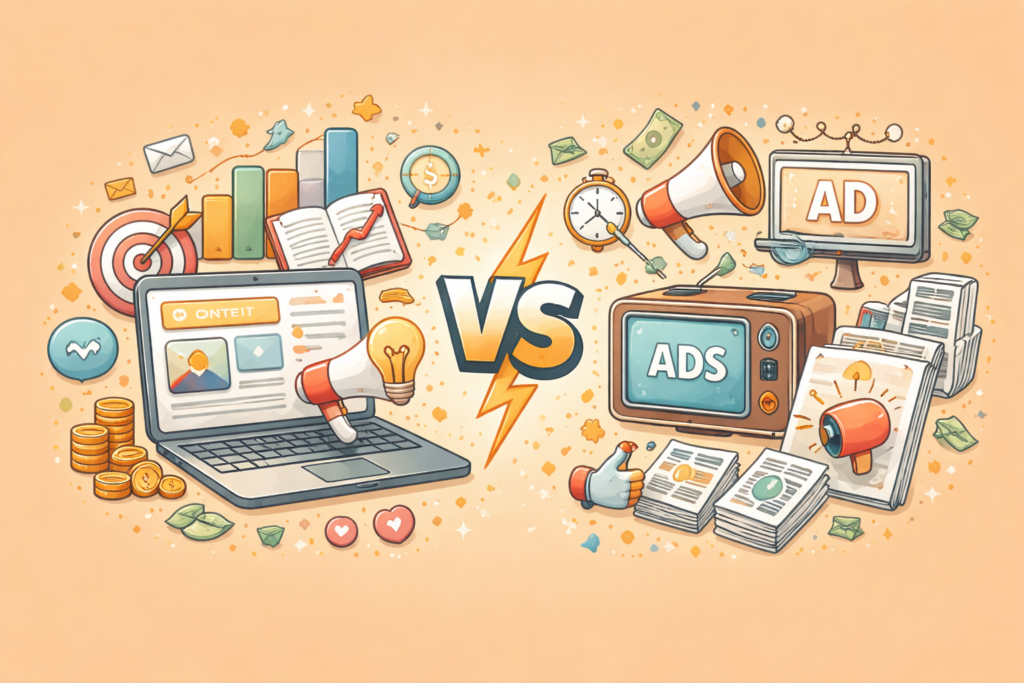
Traditional advertising focuses on interruption. Content marketing focuses on attraction.
Modern users actively ignore disruptive ads, use ad blockers, and rely on search engines and recommendations for decision-making. Content marketing aligns with this behavior by offering value instead of intrusion.
Key advantages of content marketing include:
- Lower long-term costs
- Compounding results over time
- Higher engagement and trust
- Better alignment with organic search
Studies consistently show that content marketing generates more qualified leads at a lower cost than traditional advertising because it targets users who are already interested.
Instead of pushing messages outward, content marketing pulls audiences inward—creating meaningful engagement rather than momentary attention.
SEO and Content Marketing: A Symbiotic Relationship
SEO and content marketing are deeply interconnected. Without content, SEO has nothing to optimize. Without SEO, content struggles to be discovered.
Search engines rank content—not websites. This means the quality, relevance, and structure of content directly influence SEO performance.
Effective content marketing supports SEO by:
- Targeting search intent
- Structuring content logically
- Using semantic keywords naturally
- Encouraging internal and external linking
When content is created with SEO principles in mind—but written for humans—it achieves both discoverability and engagement.
Content marketing strengthens SEO by building topical authority, which signals to search engines that a website is a reliable source on a subject.
The Importance of High-Authority External Links in Content Marketing
High-quality content marketing does not exist in isolation. Referencing reputable sources strengthens credibility and trust.
Linking to authoritative websites:
- Supports claims with evidence
- Signals trustworthiness to search engines
- Enhances user confidence
Google encourages citing reliable sources where appropriate, especially when discussing best practices, data, or industry standards.
However, links must always be:
- Contextual
- Relevant
- Purpose-driven
Random or excessive linking weakens content quality. Strategic linking, on the other hand, reinforces authority and improves perceived expertise.
Data-Driven Content Marketing: Turning Insights Into Strategy
Content marketing is most effective when supported by data.
Data-driven content:
- Increases credibility
- Improves decision-making
- Strengthens arguments
Using research, statistics, and verified insights helps content stand out in competitive search results. Data also supports content updates, optimization, and performance measurement.
Rather than relying on opinions, high-performing content marketing strategies use data to validate claims and guide users confidently.
Content Formats That Drive Sustainable Growth
Not all content types perform equally. Strategic content marketing uses formats that align with user intent and search behavior.
High-impact formats include:
- Long-form educational blogs
- Pillar pages
- Evergreen guides
- Thought leadership articles
Long-form content performs well because it provides comprehensive answers, attracts backlinks, and keeps users engaged longer.
Content marketing prioritizes quality over quantity, focusing on assets that deliver long-term value rather than short-lived traffic spikes.
User Experience and Content Structure: A Ranking Factor You Can’t Ignore

Even the most informative content fails if it is difficult to read or navigate.
User experience plays a critical role in content performance. Search engines consider engagement signals such as time on page and bounce rate when evaluating content quality.
Best practices include:
- Clear headings
- Short paragraphs
- Logical content flow
- Scannable formatting
Well-structured content improves readability, keeps users engaged, and increases the likelihood of conversions.
Aligning Content Marketing With Brand Voice and Authority
Consistency is essential in content marketing.
A clear brand voice:
- Builds familiarity
- Reinforces credibility
- Strengthens trust
Content should reflect expertise without being overly complex or promotional. Authenticity and clarity matter more than marketing language.
When content aligns with brand identity, it creates a cohesive experience that supports long-term authority and recognition.
Building a Scalable Content Marketing Framework
Content marketing delivers consistent results only when it is built on a clear, scalable framework. Without structure, content efforts often become inconsistent, reactive, and difficult to measure.
A scalable content marketing framework defines:
- The purpose of content
- The target audience
- The type of content to create
- The channels used for distribution
- The metrics used for evaluation
This framework ensures that every piece of content serves a strategic role rather than existing in isolation.
A strong content marketing framework aligns content creation with business objectives. Whether the goal is brand awareness, organic traffic growth, or lead nurturing, the framework provides direction and consistency. Over time, this approach transforms content from a marketing expense into a long-term business asset.
Topic Clusters and Pillar Content: Establishing Topical Authority
Modern content marketing focuses on topical authority, not just individual keywords. Search engines aim to rank sources that demonstrate deep understanding of a subject rather than surface-level coverage.
The topic cluster model organizes content into:
- Pillar content: comprehensive resources covering a core topic
- Cluster content: supporting articles that explore specific subtopics
This structure improves internal linking, enhances user navigation, and helps search engines understand content relevance more clearly.
For content marketing, pillar pages act as foundational resources that continuously attract organic traffic and backlinks. Supporting content reinforces the pillar topic, creating a strong ecosystem of related information.
This approach ensures that content marketing communicates expertise clearly and consistently.
Content Audits: Strengthening Existing Content Assets
Content marketing is not only about creating new content—it is also about improving what already exists.
A content audit evaluates current content to identify:
- Outdated information
- Underperforming pages
- Content gaps
- Optimization opportunities
Updating and refining existing content often produces faster results than publishing new pages. Refreshing data, improving structure, and aligning content with current search intent can significantly enhance visibility and engagement.
Regular content audits ensure that content marketing efforts remain accurate, relevant, and competitive over time.
Measuring Content Marketing Performance With Meaningful Metrics
Content marketing must be measurable to be sustainable.
Rather than focusing on vanity metrics such as page views alone, effective measurement evaluates how content supports real business outcomes.
Key performance indicators include:
- Organic traffic growth
- User engagement metrics
- Conversion rates
- Keyword visibility
- Assisted conversions
Measuring performance allows marketers to identify what works, what needs improvement, and where to invest future efforts. Data-driven evaluation transforms content marketing from guesswork into a repeatable growth process.
The Role of Trust and E-E-A-T in Content Marketing
Trust is the cornerstone of successful content marketing.
Google evaluates content quality using the E-E-A-T framework:
- Experience: real-world understanding of the topic
- Expertise: demonstrated subject knowledge
- Authoritativeness: recognition as a reliable source
- Trustworthiness: accuracy, transparency, and reliability
Content that lacks credibility struggles to rank and engage users. High-quality content marketing demonstrates expertise through depth, clarity, and proper sourcing.
Trust signals such as accurate information, transparent authorship, and authoritative references significantly improve both user confidence and search visibility.
Content Distribution: Extending the Reach of Content Marketing
Creating high-quality content is only half the equation. Distribution ensures that content reaches the right audience.
Effective content marketing uses a balanced distribution approach:
- Owned channels (websites, blogs, email newsletters)
- Earned channels (organic backlinks, mentions)
- Shared channels (social media platforms)
Strategic distribution increases visibility, accelerates indexing, and supports backlink acquisition. Without distribution, even the most valuable content may remain undiscovered.
Content Marketing and AI: Enhancing Efficiency Without Losing Quality
Artificial intelligence has transformed content workflows, but quality remains the deciding factor.
AI can support content marketing by:
- Assisting with research
- Improving content structure
- Summarizing complex information
- Identifying optimization opportunities
However, AI should enhance human expertise—not replace it. Search engines prioritize originality, accuracy, and usefulness. Content created without human insight risks being perceived as low-value.
The most effective content marketing strategies combine AI efficiency with human judgment, creativity, and experience.
Avoiding Common Content Marketing Mistakes
Many content marketing efforts fail due to avoidable mistakes.
Common challenges include:
- Publishing shallow or repetitive content
- Ignoring search intent
- Overusing keywords
- Lacking clear structure
- Failing to update content
Successful content marketing prioritizes quality, relevance, and clarity over volume. Each piece of content should serve a defined purpose and provide genuine value.
Content Marketing as a Long-Term Investment

Content marketing is not a short-term tactic—it is a long-term investment.
Unlike paid advertising, content continues to deliver value long after publication. Over time, high-quality content builds authority, attracts organic traffic, and supports brand recognition.
Businesses that treat content marketing as a strategic asset benefit from:
- Lower customer acquisition costs
- Stronger brand trust
- Sustainable growth
Consistency, patience, and quality are essential to maximizing content marketing returns.
FAQs
Q1. What is content marketing?
Content marketing is the strategic creation of valuable content to attract, engage, and retain an audience.
Q2. Why is content marketing important?
It builds trust, supports SEO, and delivers long-term growth.
Q3. How does content marketing help SEO?
It improves topical authority, keyword rankings, and organic visibility.
Q4. How long does content marketing take to work?
Results typically appear within 3–6 months, depending on competition.
Q5. Is long-form content better?
Yes, long-form content often ranks higher and engages users longer.
Q6. How often should content be updated?
Every 6–12 months for evergreen topics.
Q7. Does content marketing generate leads?
Yes, indirectly through trust and education.
Q8. Can AI-written content rank?
Yes, if it meets quality and usefulness standards.
Q9. How do you measure content success?
Through traffic, engagement, and conversions.
Q10. Is content marketing cost-effective?
Yes, it delivers compounding ROI over time.
Conclusion
Content marketing is not about publishing content frequently—it is about publishing content purposefully. When executed with clarity, consistency, and a user-first mindset, content marketing becomes a long-term growth engine that builds trust, authority, and sustainable visibility.
In today’s competitive digital environment, users rely on high-quality content to educate themselves, compare options, and make confident decisions. Search engines reward the same behavior. This is why content marketing sits at the intersection of user experience, SEO, and brand credibility.
For Appledew UK, content marketing plays a crucial role in establishing expertise, strengthening online presence, and supporting long-term digital growth. By focusing on valuable, informative, and well-structured content, Appledew UK can position itself as a trusted authority while meeting Google’s quality expectations.
Effective content marketing delivers value in multiple ways:
- Builds trust by educating users instead of selling aggressively
- Improves organic search visibility through helpful, intent-driven content
- Strengthens brand authority using consistency and expertise
- Supports the entire buyer journey from awareness to decision-making
- Creates long-term assets that continue to perform over time
Rather than chasing short-term results, content marketing rewards patience and strategic thinking. Each high-quality piece contributes to a growing knowledge base that benefits both users and search engines.
In conclusion, content marketing is not a one-time tactic—it is a strategic investment. For brands like Appledew UK, committing to meaningful, data-informed, and user-focused content is the key to building digital trust, achieving sustainable growth, and standing out in an increasingly crowded online landscape.
AI Implementation Prompt
Want to implement what you’ve just read?
Use the prompt below in ChatGPT to turn this strategy into an actionable plan for your website.
You are an experienced content marketing and SEO strategist.
Based on the blog post “Content Marketing Explained: How Brands Build Trust, Authority, and Growth”, create a step-by-step content marketing implementation plan for my website.
The plan must:
- Follow Google’s Helpful Content System and Search Quality Guidelines
- Apply E-E-A-T (Experience, Expertise, Authoritativeness, Trustworthiness)
- Map content to the buyer journey (awareness, consideration, decision)
- Recommend pillar pages, topic clusters, and internal linking
- Suggest high-authority external links where relevant
- Focus on people-first, long-term SEO growth
Present the response in clear steps with headings and bullet points.
End with a short implementation checklist.
Want our help?
👉 Reach out via our website contact form: [https://appledew.co.uk/contact-us/]